Roti Canai with Dhal
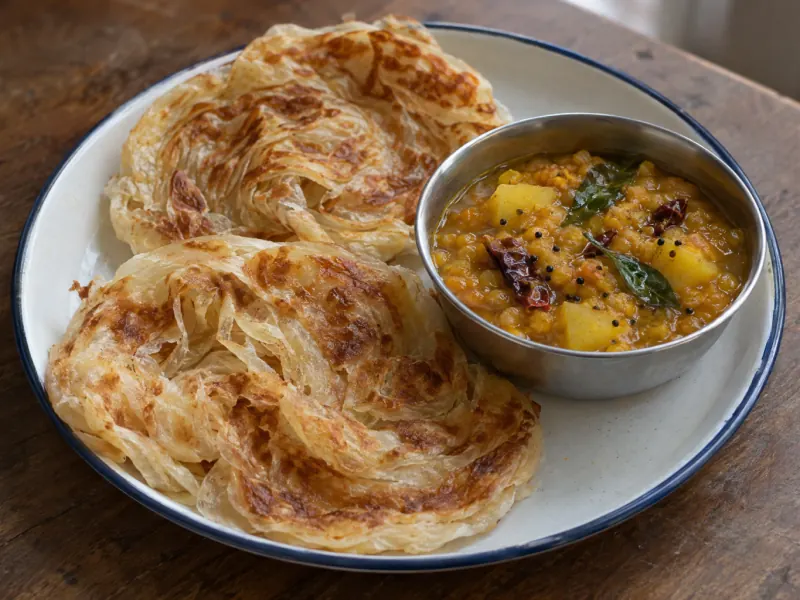
Roti canai (ROH-tee chah-NIGH) is a layered, crisp-edged flatbread, usually eaten with dhal for dipping. This home version needs no tossing: a soft, egg-enriched dough rests in oil for two hours so it stretches thin on the worktop, and a quick scrunch straight off the pan opens up the layers.
- Total3 h 50 min
- Servings8
- DifficultyMedium
Ingredients
Roti
Dhal
Method
Make the dough
Mix the flour, salt and sugar in a large bowl. Whisk the egg with the water and ¾ oz (21 g) melted ghee, pour into the flour and knead for 10 minutes by hand, or 6–7 minutes in a stand mixer with a dough hook.
Look for: The dough is smooth, very soft and slightly tacky, and springs back slowly when poked.
Rest and divide
Cover the bowl and rest the dough for 15 minutes, then knead it for another 2 minutes. Divide it into eight equal pieces and roll each into a tight, smooth ball.
Look for: The surface of each ball is smooth with no cracks.
Rest the balls in oil
Pour the oil into a baking dish, roll the balls in it so they are fully coated and leave them seam side down. Cover tightly and rest at room temperature for at least 2 hours, or overnight in the fridge.
Look for: The balls have slumped and feel slack and silky when pressed.
Simmer the lentils
While the dough rests, put the lentils, 3¼ cups (765 ml) water, the turmeric and the potato in a saucepan. Bring to a boil, skim off any foam, then simmer partly covered for 20–25 minutes, stirring now and then.
Look for: The lentils have collapsed into a thick purée and a knife slides easily through the potato.
Make the tempering
Heat the ghee in a frying pan over medium heat, add the mustard seeds and cover with a lid or splatter guard, as they will spit; wait until they pop. Add the cumin seeds, chillies and curry leaves and fry for 30 seconds, then add the onion, garlic and ginger and cook for 6–8 minutes. Stir in the curry powder and cook for 1 minute, then add the tomato and cook for 3–4 minutes.
Look for: The onion is soft and golden and the tomato has broken down into a jammy paste.
Finish the dhal
Scrape the tempering into the lentils, add the salt and the remaining ½ cup (135 ml) water, and simmer for 5 minutes. Keep warm over the lowest heat.
Look for: The dhal is pourable but coats a spoon. It thickens further as it stands.
Stretch the dough
Smear a clean worktop and your palms with a little oil from the dish. Flatten one ball, press it outwards with your palms, then lift and pull the edges gently all round until the sheet is paper-thin and about 17½ in (45 cm) across. A few small holes do not matter.
Look for: You can see the worktop through the dough.
Fold into layers
Drizzle a little of the remaining melted ghee over the sheet. Fold the top and bottom edges into the middle, then the two sides, to make a layered square about 6 in (15 cm) wide.
Look for: The square is even in thickness with no thick lumps of dough at the corners.
Griddle in ghee
Heat a heavy frying pan or tawa over medium-high heat, add about a tablespoon of the ghee and lay in the square. Press it out slightly and cook for 2–3 minutes per side, adding a little more ghee when you turn it; if the ghee runs low, use oil from the dish.
Look for: Both sides are deep golden with darker blistered spots, and the edges are crisp with no pale, raw-looking patches.
Scrunch and serve
Tip the hot roti onto a board or the worktop and push it together from the sides with both hands, like a quick clap, to loosen the layers. Keep cooked roti loosely wrapped in a tea towel (dish towel) while you cook the rest. Stretch and fold the next ball while each roti cooks, and repeat with the remaining dough. Serve with the dhal.
Look for: The roti crumples and the flaky layers separate visibly.
Why this works
- The 2-hour rest in oil relaxes the gluten so fully that the dough stretches thin without springing back. Short-cutting this rest is a common reason home roti tears.
- About 1.8% salt to flour seasons the bread, and the tablespoon of sugar helps the thin layers brown on the griddle before they dry out.
- Brushing the stretched sheet with ghee before folding keeps the layers apart as they cook, which is what makes the bread flaky rather than bready.
- Medium-high heat cooks the folded square through in 2–3 minutes per side. Higher heat scorches the outside before the inner layers are cooked.
Common mistakes
- Stretching cold dough straight from the fridge makes it tear and shrink back. Let refrigerated balls sit at room temperature for an hour first.
- Using too little oil on the worktop and your hands makes the dough stick and rip. Keep everything slick with oil from the dish.
- Skipping the scrunch leaves the layers stuck together and less flaky. Crush the roti while it is still hot, or the layers set together.
Swaps
- ghee → margarine or a neutral oil. Many cooks use margarine or oil instead of ghee. The roti will still be flaky, but less buttery.
- large egg → 30 ml extra water. Some recipes leave out the egg. Without it the dough is slightly less tender but stretches just as well.
- red lentils (masoor dal) → yellow split peas or chana dal. Soak them for 1 hour and simmer for about 45 minutes, until soft, adding a little more water if needed.
- fresh curry leaves → frozen curry leaves, or leave them out. Fresh or frozen curry leaves are sold in Indian and Asian grocers. Dried ones add little flavour.
Storage
Roti canai is crispest straight from the pan. Cooked roti keep for 2 days in the fridge or 2 months in the freezer, layered with baking paper (parchment). Reheat them in a dry frying pan over medium heat for 1–2 minutes per side. Uncooked folded squares can be frozen between sheets of baking paper (parchment) and griddled from frozen, adding a minute per side. The dhal keeps for 4 days in the fridge or 3 months frozen. Reheat it until steaming, adding a splash of water.
Scaling
Doubling works well. Knead the dough in two batches if your mixer bowl is small, and use a larger dish or two dishes for the oil rest. The rest time stays the same. Cook the roti one at a time and keep the cooked ones loosely wrapped in a tea towel (dish towel). To halve the recipe, use half a beaten egg (about 25 g) and simmer the dhal in a smaller pan, checking it 5 minutes early.
Make ahead
The oiled dough balls can rest in the fridge for up to 24 hours. Bring them to room temperature for 1 hour before stretching. The dhal can be made a day ahead and reheated with a splash of water.
Nutrition per serving
- Calories
- 675 kcal
- Protein
- 14 g
- Carbohydrates
- 72 g
- Sugars
- 3 g
- Fibre
- 6 g
- Fat
- 37 g
- Saturated fat
- 15 g
- Sodium
- 745 mg
Estimated from the raw ingredients using USDA FoodData Central values; actual values vary with brands and portion size.
Contains
- Gluten
- Milk
- Egg
- Soy
- Mustard
Derived from the ingredient list. Always check the labels of the products you buy. Allergens and health
Questions
Do I have to toss the dough like the street vendors?
No. Pressing and pulling the dough on an oiled worktop gets it just as thin. Tossing is faster once you have the knack, but it is not needed for flaky layers.
Why are my roti tough instead of flaky?
Usually the dough was too firm or didn't rest long enough, so it could not be stretched thin. Too little ghee between the folds also lets the layers fuse. Keep the dough soft, rest it for the full 2 hours and drizzle each sheet before folding.
What else can I serve with roti canai?
Besides dhal, it is commonly eaten with chicken or fish curry, with sambal, or sprinkled with sugar or drizzled with condensed milk.
Cook next




Published November 20, 2026 · Updated · Published by Recipe Worldwide · How we make recipes