Nigerian Meat Pie
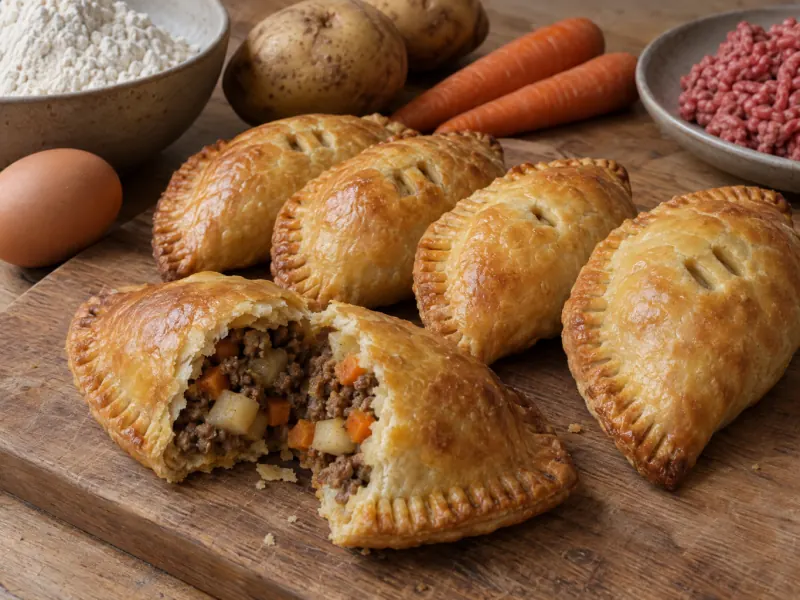
Nigerian meat pie (nye-JEER-ee-un MEET pye) is a crimped half-moon of buttery shortcrust around curried minced beef, potato and carrot. This version thickens the filling with a flour slurry and cools it fully before the pies are shaped, so the pastry stays crisp and the edges seal without leaking.
- Total2 h 10 min
- Servings12
- DifficultyMedium
Ingredients
Pastry
Filling
Egg wash
Method
Rub the butter into the flour
Whisk the flour and salt together in a large bowl. Add the cold butter and rub it in with your fingertips until the mixture looks like coarse breadcrumbs.
Look for: Coarse, sandy crumbs with a few pea-sized flecks of butter still visible.
Bind and chill the pastry
Sprinkle in the cold water a little at a time, mixing with a table knife, until the crumbs clump; you may not need all of it. Press into a flat disc without kneading, wrap and refrigerate for 30 minutes.
Look for: The dough holds together when squeezed and is not sticky or wet.
Brown the beef and onion
Heat the oil in a wide pan over medium-high heat, add the beef and onion together and cook, breaking the meat into small crumbs, for 8–10 minutes, until no pink remains and the meat reaches 160 °F (71 °C). Spoon off any excess fat before adding the spices, then stir in the curry powder, thyme, crumbled stock cube and black pepper and cook for 1 minute more.
Look for: No pink remains in the beef, the onion is soft and the crumbs reach 160 °F (71 °C); the spices smell toasted.
Simmer the vegetables
Add the potato, carrots and ¾ cup (200 ml) of water, stir, cover and simmer over low heat for 10–12 minutes, stirring once or twice.
Look for: A knife slides easily through a cube of potato and carrot.
Thicken the filling
Mix the flour with the remaining 3½ tbsp (50 ml) of water until smooth, stir it into the pan and cook uncovered for 2–3 minutes. Taste and add salt.
Look for: The liquid turns glossy and thick, and a spoon drawn through the pan leaves a clear path.
Cool the filling and heat the oven
Spread the filling on a plate or tray and let it cool completely. Meanwhile heat the oven to 375 °F (190 °C), setting it a little lower if you use a fan oven, and line two baking trays (sheets) with baking paper (parchment).
Look for: The filling feels cool to the touch all the way through.
Roll and cut the pastry
Dust the work surface with the extra flour and roll the pastry to about ⅛ in (0.3 cm) thick, then cut out circles of 5½ in (14 cm) using a saucer as a guide. Gather the scraps, press together, re-roll once and cut more circles to make twelve in total.
Look for: The pastry rolls without cracking; if it softens and sticks, chill it for 10 minutes.
Fill and seal
Put about 2 heaped tablespoons (roughly 1¾ oz (50 g)) of cooled filling on one half of each circle, leaving a clear border; any leftover filling can be frozen. Brush the border with beaten egg, fold the pastry over and press the edges together, then crimp them with a fork.
Look for: The edges are firmly stuck with no filling caught in the seam.
Glaze and vent
Set the pies on the lined trays, brush the tops with the rest of the egg and prick each one twice with a fork so steam can escape.
Look for: An even, thin coat of egg with no pools on the tray.
Bake
Bake at 375 °F (190 °C) for 25–30 minutes, swapping the trays halfway through, until the pastry is deep golden. Cool on the trays for 10 minutes before serving.
Look for: Deep golden tops, browned edges and undersides that look dry and lightly coloured when lifted.
Why this works
- A 2:1 ratio of flour to cold butter gives a short, crumbly pastry that still holds a crimp; rubbing the butter in rather than melting it keeps the crust tender rather than greasy.
- The 2 tablespoons of flour mixed into the last of the water binds the cooking liquid, so the filling stays moist without soaking the pastry from inside.
- Dicing the potato and carrot to about 5 mm means they cook through in the 10–12 minute simmer and fit inside a folded pie without tearing the pastry.
- Cooling the filling completely before shaping stops the butter in the pastry from melting, which is what makes pies slump and leak in the oven.
Common mistakes
- A filling that still has loose liquid after the slurry makes soggy undersides and leaks at the crimp; if broth pools when you tilt the pan, cook uncovered for another 1–2 minutes until a spoon leaves a clear path.
- Overfilling or getting filling on the edge prevents a seal; keep to about 2 heaped tablespoons per pie, leave a clear border, brush it with egg and crimp firmly with a fork.
- Adding all the cold water at once or kneading the dough makes the crust tough and prone to shrinking; add water gradually and press the dough together just until it holds.
Swaps
- minced beef (ground beef) → minced chicken. Gives the chicken pie variant; cook the mince until no pink remains and it reaches 74°C (165°F).
- unsalted butter (2 sticks plus 2 tbsp) → half butter, half baking margarine. A common mix in Nigerian home baking; use block margarine, not soft spread, and keep it cold.
- beef stock cube (bouillon cube) → 1 tsp beef stock powder. Check the salt at the end before adding more, as powders vary in saltiness.
- ground black pepper → half a scotch bonnet (atarodo), seeded and finely chopped. Add with the onion for the hotter version of the filling.
Storage
Keep cooled pies in an airtight container in the fridge for up to 3 days. Reheat on a tray in a 180°C (350°F) oven for 10–12 minutes so the crust re-crisps; the microwave softens the pastry. Baked pies freeze for up to 3 months; reheat from frozen at the same temperature for 20–25 minutes. Leftover cooked filling freezes for up to 3 months; thaw it in the fridge before using.
Scaling
Halving works directly: use one tray and the same baking time. When doubling, make the pastry in two batches so the butter stays cold, brown the beef in two batches or a very wide pan so it browns rather than steams, and bake no more than two trays at a time, adding 3–5 minutes if the oven is full.
Make ahead
The pastry keeps wrapped in the fridge for 2 days and the cooked filling for 2 days. Shaped, unbaked pies can be frozen on a tray, then bagged; bake from frozen at the same temperature, brushing with fresh egg and adding 8–10 minutes.
Nutrition per serving
- Calories
- 435 kcal
- Protein
- 12 g
- Carbohydrates
- 40 g
- Sugars
- 1 g
- Fibre
- 2 g
- Fat
- 26 g
- Saturated fat
- 13.4 g
- Sodium
- 235 mg
Estimated from the raw ingredients using USDA FoodData Central values; actual values vary with brands and portion size. Salt added to taste is not included. A small amount of a flavouring without reliable nutrition data is not included.
Contains
- Gluten
- Milk
- Egg
- Soy
- Mustard
- Celery
Derived from the ingredient list. Always check the labels of the products you buy. Allergens and health
Questions
Can I freeze Nigerian meat pies?
Yes, either baked or unbaked. Unbaked pies keep their pastry texture slightly better; bake them straight from the freezer with an extra 8–10 minutes.
Why did my meat pies burst open in the oven?
Usually the filling was warm or too wet, the pies were overfilled, or the edges were not sealed with egg. Steam also needs a way out, so prick the tops before baking.
Should the pastry have baking powder in it?
Some versions add about a teaspoon to the flour for a slightly lighter, cake-like crust. This recipe leaves it out for a shorter, crisper shortcrust, but adding it will not cause problems.
Cook next
Published November 20, 2026 · Updated · Published by Recipe Worldwide · How we make recipes