Simit
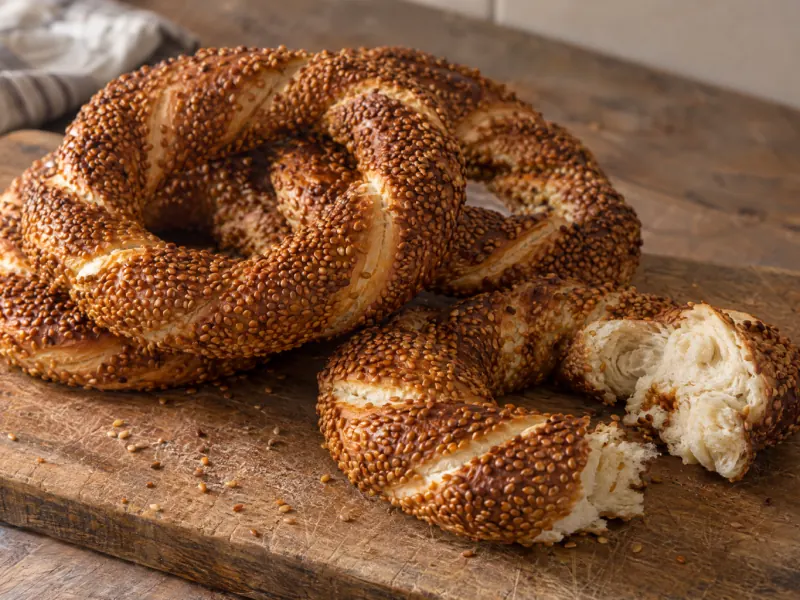
Simit (sih-MIT) is the Turkish sesame-crusted bread ring, dipped in grape molasses and baked without boiling first. This version uses a firm, oil-free dough and pre-toasted sesame. The crust bakes crisp and deep brown while the inside stays soft and slightly chewy.
- Total3 h
- Servings8
- DifficultyMedium
Ingredients
dough
coating
Method
Toast the sesame
Toast the sesame seeds in a dry frying pan over medium heat, stirring often, for 4–5 minutes. Tip them into a wide, shallow dish to cool.
Look for: Seeds are pale gold and smell nutty; pull them before any turn brown.
Knead the dough
Mix the flour, yeast and salt in a large bowl, then add the lukewarm water and bring it together. Knead by hand for about 10 minutes, or 6–7 minutes in a stand mixer on low.
Look for: The dough is firm, smooth and springs back slowly when pressed; it should not stick to your hands.
First rise
Cover the bowl and leave the dough in a warm place for about 1 hour.
Look for: Roughly doubled in size; a floured finger pressed into the dough leaves a dent that springs back only slowly.
Divide and relax
Turn the dough out, knock it back (punch it down) and divide it into 16 equal pieces of about 1¾ oz (50 g) each. Roll each into a ball, cover with a cloth and rest for 10 minutes so the gluten relaxes and the ropes roll out without shrinking.
Look for: The pieces are even in size, and the balls feel relaxed and slightly puffy.
Make the molasses dip
Whisk the grape molasses with the water in a shallow dish wide enough to lay a ring flat. Line two baking sheets with baking paper (parchment).
Look for: The mixture is smooth and evenly brown with no streaks of thick molasses.
Shape the rings
Preheat the oven to 425 °F (220 °C). Roll two balls into ropes about 19½ in (50 cm) long, lay them side by side, pinch one end together and twist them around each other. Bring the ends together to make a ring about 6 in (15 cm) across, overlap them and press firmly to seal; repeat to make eight rings.
Look for: The twist is tight and even, with the join pressed flat so it will not open in the oven.
Dip and coat
Dip each ring in the molasses dip, turning it so every surface is wet, and lift it out to let the excess drip off. Lay it in the sesame seeds, press gently, flip and press again, then move it to a lined baking sheet, four rings per sheet.
Look for: Rings are completely covered in seeds with no bare dough showing.
Short proof
Leave the first sheet of rings uncovered for 15–20 minutes. While the first sheet bakes, keep the second in a cool spot, or shape and coat its rings about 15 minutes after the first so it is ready when the oven is free. Just before baking, gently stretch any rings that have closed up to reopen the centre.
Look for: Rings look slightly puffy but still hold a clear twist.
Bake
Bake one sheet at a time on the middle shelf at 425 °F (220 °C) for 18–22 minutes, turning the sheet halfway through.
Look for: Deep golden brown all over, crisp to the tap, and the underside sounds hollow.
Cool
Move the simit to a wire rack and cool for at least 10 minutes before breaking them open.
Look for: The crust stays crisp as they cool rather than softening.
Why this works
- The dough is about 60% hydration (300 ml water to 500 g flour). A firm dough holds the twist and keeps the rings from spreading, and a wetter dough blurs the shape.
- Grape molasses thinned with water (80 ml to 120 ml) acts as glue for the sesame. Its sugars brown fast at 220°C, giving the dark, glossy crust without boiling the rings first.
- Toasting the sesame beforehand gives a deeper, nuttier crust. Untoasted seeds colour less in the time the bread takes to bake, so the crust is paler and milder.
- Baking one sheet at a time on the middle shelf at high heat crisps the shell quickly while the inside stays soft. A crowded oven steams the rings and dulls the crust.
Common mistakes
- Adding extra water to make kneading easier gives slack rings that lose their twist. Keep the dough firm, and rest it for a few minutes if it fights back.
- Dipping too briefly or letting the rings dry before the sesame goes on leaves bald patches. Coat each ring straight from the dip and press the seeds in on both sides.
- Rolling the ropes too thin or baking too long gives a dry, rusk-like simit. Aim for ropes about as thick as a finger and pull them once they are deep golden.
Swaps
- grape molasses (pekmez) → date syrup or carob molasses. Use the same amount. Both are easier to find than pekmez in some areas, brown in a similar way and taste a little different.
- grape molasses (pekmez) → pomegranate molasses. Some recipes use it. It is much tarter, so use 40 ml with 2 tbsp honey and the same water.
- bread flour (strong white flour) → all-purpose (plain) flour. Use 280 ml water instead of 300 ml. The crumb will be slightly less chewy.
- instant dry yeast → active dry yeast. Use 2½ tsp and dissolve it in the lukewarm water for 5 minutes before mixing. Allow a slightly longer rise.
Storage
Simit is best on the day it is baked. Keep leftovers in a paper bag at room temperature for up to 2 days rather than in the fridge, which stales them faster. Freeze in a sealed bag for up to 1 month. Reheat thawed or frozen simit at 180°C (350°F) for 5–8 minutes to re-crisp the crust.
Scaling
To double, mix the dough in two batches unless your mixer is large, and make a second batch of molasses dip when the first gets thick with seeds. Bake one sheet at a time, which adds about 40 minutes of oven time. Stagger the sheets so none waits too long: shape and coat each sheet about 15–20 minutes after the previous one, and keep the divided dough balls covered in a cool spot until their turn. To halve, keep the same oven temperature and baking time per sheet.
Make ahead
After kneading, cover the dough and refrigerate for 12–16 hours instead of the first rise. Shape it straight from the fridge and give the coated rings 30 minutes to proof instead of 15–20. The sesame can be toasted up to a week ahead and stored airtight once cool.
Nutrition per serving
- Calories
- 385 kcal
- Protein
- 12 g
- Carbohydrates
- 58 g
- Sugars
- 11 g
- Fibre
- 4 g
- Fat
- 13 g
- Saturated fat
- 1.9 g
- Sodium
- 450 mg
Estimated from the raw ingredients using USDA FoodData Central values; actual values vary with brands and portion size.
Contains
- Gluten
- Sesame
Derived from the ingredient list. Always check the labels of the products you buy. Allergens and health
Questions
Do I need to boil simit like a bagel?
No. Simit is dipped in diluted molasses and baked without boiling, which is the main difference from a bagel. The molasses gives the colour and the crisp shell.
Why did the sesame seeds fall off after baking?
The ring was usually not wet enough when it went into the seeds, or the seeds were not pressed in. Dip each ring fully, drain it briefly and press it into the sesame on both sides straight away.
Can I add oil to the dough?
Some versions add a tablespoon or two of oil for a slightly softer crumb. This recipe leaves it out to keep the crust crisper, but adding 1 tbsp olive or sunflower oil works without other changes.
Cook next

Published November 20, 2026 · Updated · Published by Recipe Worldwide · How we make recipes