Curry Laksa
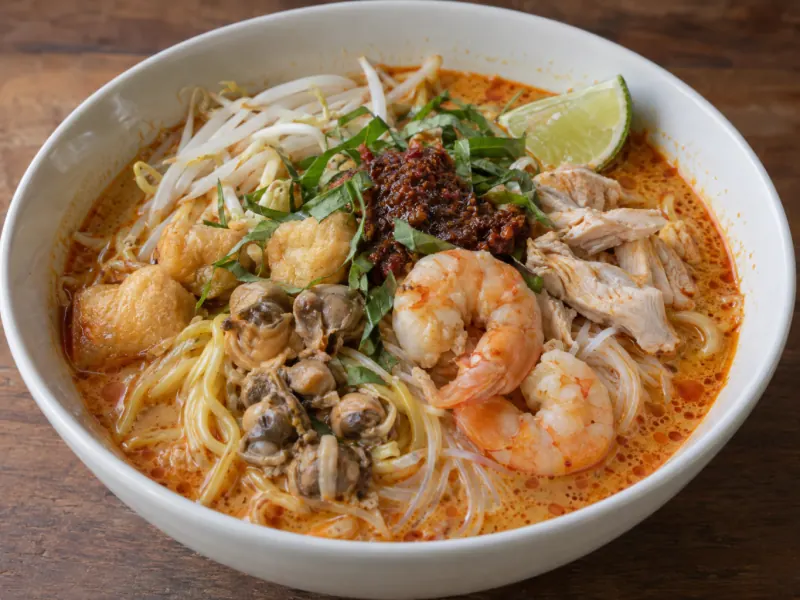
Curry laksa (KUH-ree LAHK-sah) is a Malaysian noodle soup of egg noodles and rice vermicelli in a chilli-red coconut broth. This version starts with a fresh paste of dried chillies, lemongrass and toasted belacan, fried slowly until the oil separates. Poaching the chicken in the broth seasons the meat and adds a little extra chicken flavour.
- Total1 h 40 min
- Servings4
- DifficultyMedium
Ingredients
spice paste
broth
noodles and toppings
Method
Soak the dried chillies
Snip the dried chillies into short pieces, shaking out most of the seeds for a milder paste. Cover with the just-boiled soaking water and soak for 15 minutes, then drain and discard the soaking water.
Look for: The chillies are soft and bend without snapping.
Toast the belacan
Open a window or turn on the extractor fan, because the smell is strong. Wrap the belacan in a small foil parcel and toast it in a dry frying pan over medium heat for 2–3 minutes per side.
Look for: It smells strongly toasty and has turned dry and crumbly.
Blend the spice paste
Put the drained dried chillies, fresh chillies, shallots, garlic, lemongrass, galangal, candlenuts, crumbled belacan, turmeric and coriander in a blender with 1½ tbsp (23 ml) of the oil. Blend, scraping down the sides often, until smooth; add a little more of the oil if the blades stall.
Look for: A thick, even red paste with no stringy pieces of lemongrass.
Fry the paste
Heat the remaining oil (about ¼ cup (68 ml) of the oil) in a large pot over medium-low heat and add the paste. Fry, stirring often and scraping the base, for 10–12 minutes.
Look for: The paste darkens to brick red, smells sweet rather than raw, and red oil pools at the edges.
Poach the chicken in the stock
Pour in the stock, scraping up anything stuck to the pot, and bring to a simmer. Add the chicken and simmer gently, partly covered, for 15–18 minutes until it reaches 165 °F (74 °C) in the thickest part, then lift it out and slice or shred it.
Look for: The meat is white all the way through and the juices run clear.
Add the coconut milk and tofu puffs
Lower the heat, stir in the coconut milk, sugar and salt, and add the tofu puffs. Keep at a gentle simmer for 8–10 minutes, then taste and add more salt if needed.
Look for: The broth is glossy orange-red with beads of oil on top, and the tofu puffs are soft and soaked through.
Blanch the sprouts and warm the bowls
While the broth simmers, bring the water to a boil in a separate pot, blanch the bean sprouts for 20 seconds and lift them out. Fill four deep bowls with hot tap water to warm them.
Look for: The sprouts have lost their raw look but still snap.
Cook the noodles and seafood
Drop the vermicelli into the boiling water and cook according to the packet, usually 3–5 minutes. About 2 minutes before it is done, add the prawns to the simmering broth; for the final 1–2 minutes, add the egg noodles to the water and the cockles to the broth, cooking until the prawns are pink, opaque and loosely curled (about 145 °F (63 °C) if you check). Drain the noodles, empty the warmed bowls and divide the noodles between them.
Look for: The prawns are pink, opaque and curled into a loose C, the cockles are hot but still plump, and both noodles are separated and just tender.
Assemble the bowls
Top the noodles with the bean sprouts and chicken, then ladle over the hot broth with the tofu puffs, prawns and cockles. Finish with laksa leaves and a spoonful of sambal, and put a lime wedge on the side.
Why this works
- Frying the paste slowly for 10–12 minutes, until the oil separates, cooks out the raw edge of the shallots, garlic and chillies; underfried paste makes a broth that tastes harsh and flat.
- Toasting the belacan first takes away its raw fishiness and leaves a deep, roasted savouriness that runs through the whole broth.
- Poaching the chicken thighs in the stock seasons the meat and adds a little extra chicken flavour, so no separate pot is needed for the chicken.
- Cooking the noodles in a separate pot keeps their starch out of the broth and stops them going soft before serving.
Common mistakes
- Frying the paste over high heat scorches the chillies and makes the broth bitter; keep it at medium-low and stir often, adding a spoonful of oil if it starts to catch.
- Boiling the broth hard after the coconut milk goes in can split it into a grainy, oily layer; keep it at a gentle simmer.
- Leaving the prawns and cockles in the broth too long makes them rubbery; add them right before serving, cockles for the last minute only.
Swaps
- candlenuts → 4 macadamia nuts. Candlenuts can be hard to find outside Asian grocers; unsalted macadamias thicken the paste the same way.
- cockles, cooked and shelled (frozen or in brine) → cooked clam meat or canned baby clams. Cockles are sold frozen at Asian grocers and in jars of brine in the UK and Australia; if you cannot find them, clams have a similar briny sweetness and are heated through the same way. Both are molluscs, so leave them out for anyone with a mollusc allergy.
- laksa leaves (Vietnamese mint) → mint and fresh coriander (cilantro) leaves. Vietnamese mint is sold at Asian grocers; mint with fresh coriander (cilantro) gives a similar fresh, peppery finish.
- fresh galangal → the same weight of fresh ginger. Ginger is warmer and less piney, but it works if galangal is not available; frozen galangal is also a good option.
Storage
Store the broth (with the tofu puffs) in the fridge for up to 3 days, separately from the chicken and seafood; keep the cooked chicken and any leftover prawns and cockles covered in the fridge and use within 1–2 days. The broth without seafood freezes for up to 3 months; it may look slightly split after thawing and comes back together when whisked as it reheats to a steady simmer. Do not freeze the prawns or cockles. Cooked noodles go soft, so cook fresh noodles when reheating.
Scaling
To double, use a pot of at least 6 litres and allow 15–18 minutes to fry the larger batch of paste until the oil separates. Poach the chicken in a single layer, or in two batches, so it cooks evenly. Halving works in a medium saucepan, and the paste will be ready a few minutes sooner.
Make ahead
The spice paste, raw or already fried, keeps in a sealed jar in the fridge for up to 3–4 days, or frozen for 3 months; keep it chilled and never store it at room temperature. The broth can be made up to the end of the tofu puff step a day ahead; reheat it gently, then cook the noodles and seafood just before serving.
Nutrition per serving
Nutrition is not shown because it could not be calculated reliably from the ingredients.
Contains
- Gluten
- Egg
- Tree nuts
- Soy
- Shellfish
- Celery
Derived from the ingredient list. Always check the labels of the products you buy. Allergens and health
Questions
Can bought laksa paste be used instead of homemade?
Yes. Use roughly 4–5 tablespoons of a good laksa paste in place of the homemade paste and fry it in the oil for about 5 minutes until fragrant before adding the stock. Taste before salting, as bought pastes are often salty.
Is curry laksa the same as curry mee?
In Penang the two names are often used for the same coconut curry noodle soup, though some cooks use 'laksa' only for the coconut-rich version. This recipe follows the egg-noodle-and-vermicelli style with cockles, which is one common version rather than the only correct one.
Where is belacan sold, and is there a substitute?
Belacan is sold in blocks at Asian grocers, sometimes labelled 'shrimp paste'. A jarred shrimp paste such as Thai kapi works in the same quantity; skip the toasting step if it is soft and wet.
Cook next
Published November 20, 2026 · Updated · Published by Recipe Worldwide · How we make recipes