Pabellón Criollo (Venezuelan Shredded Beef, Black Beans and Rice)
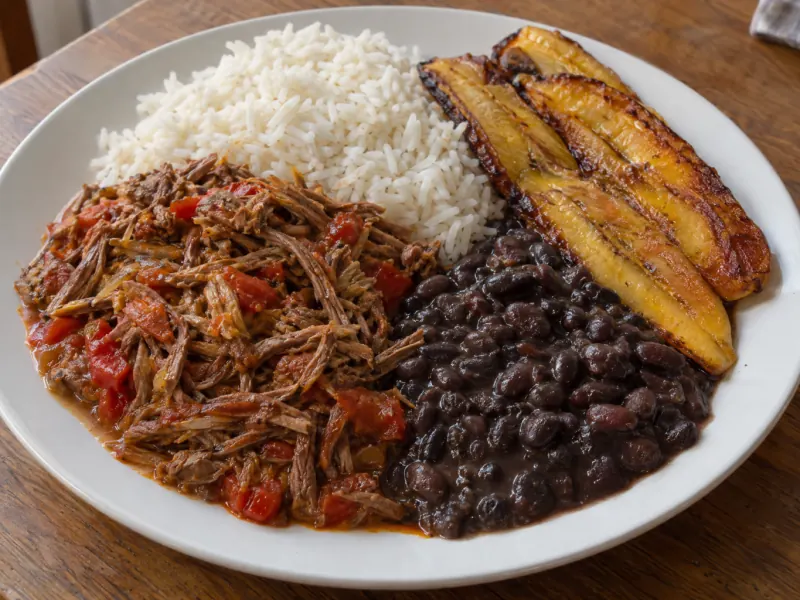
Pabellón criollo (pah-beh-YOHN KREE-oh-yoh) is considered Venezuela's national dish: shredded beef (carne mechada), stewed black beans (caraotas negras), white rice and fried sweet plantains on one plate. Here flank steak is simmered until it pulls into long strands, then finished in a reduced pepper and tomato sauce.
- Total11 h 20 min
- Servings6
- DifficultyMedium
Ingredients
Shredded beef
Black beans
Rice
Fried plantains
Method
Soak the beans
Put the beans in a large bowl, cover with 6½ cups (1.5 l) cold water and leave to soak for 8 hours or overnight.
Look for: The beans have roughly doubled in size and the skins are smooth.
Simmer the beans
Drain the beans, tip them into a large pot and pour in enough of the water to cover them by about 2 in (5 cm), keeping the rest to top up as they cook. Bring to the boil, skim off any foam, then lower the heat and simmer, partly covered, for 60–90 minutes until tender.
Look for: A bean crushes easily between your fingers and is creamy all the way through, with no chalky centre.
Simmer the beef
Meanwhile, put the beef in a second large pot with the water, the onion chunks, the crushed garlic clove and 1 tsp of the salt. Bring to the boil, skim, then cover and keep at a bare simmer for 1½–2 hours. The beef passes the safe 145 °F (63 °C) long before it is tender, so judge it by texture.
Look for: A fork slides in with no resistance and the meat starts to separate into strands along the grain.
Shred the beef
Lift the beef onto a board, set aside 1¼ cups (300 ml) of the cooking broth (the rest can be cooled and kept for soup) and let the meat rest for 15 minutes until cool enough to handle. Pull it apart with two forks or your fingers into long, thin strands, discarding any fat or gristle.
Look for: The strands are long and fine, about the thickness of a pencil lead.
Make the beef sauce base
Heat the oil for the beef in a wide frying pan over medium heat. Add the remaining chopped onion and the red pepper and cook for 8–10 minutes, stirring often, then add the chopped garlic for 1 minute and the tomatoes for 5 minutes more.
Look for: The onion and pepper are soft and sweet-smelling and the tomatoes have collapsed into a thick sauce.
Finish the shredded beef
Stir the shredded beef (carne mechada, as it is called in Venezuela) into the pan with the reserved broth, the rest of the salt and the black pepper. Simmer uncovered for 15–20 minutes, stirring now and then, until the liquid has reduced to a sauce that coats the meat.
Look for: Only a little glossy sauce collects when you push the beef to one side of the pan.
Cook the bean seasoning
When the beans are tender, heat the oil for the beans in a small frying pan over medium heat. Cook the onion and red pepper for 6–8 minutes until soft, then stir in the garlic and cumin for 1 minute.
Look for: The vegetables are soft and the cumin smells toasty but has not darkened.
Thicken the beans
Scrape the onion mixture into the beans and add the salt and the sugar, if using. Simmer uncovered for 20–40 minutes, crushing a few beans against the side of the pot, until the cooking water has thickened into a creamy sauce; if it is still thin, crush more beans. These stewed beans are the caraotas negras of the dish.
Look for: The beans sit in a dark sauce about as thick as gravy that coats a spoon.
Cook the rice
Heat the oil for the rice in a heavy saucepan over medium heat and stir the drained rice in it for 1–2 minutes. Add the water and salt, bring to the boil, then cover tightly, turn the heat to its lowest setting and cook for 18 minutes; leave covered off the heat for 5 minutes, then fluff with a fork.
Look for: All the water has been absorbed and small steam holes dot the surface of the rice.
Fry the plantains
Cut each plantain in half crosswise, then lengthwise into slices about ⅓ in (1 cm) thick. Pour the oil into a large frying pan (it should be about ¼ in (0.5 cm) deep) and heat it to 345 °F (175 °C), or until a slice sizzles steadily as soon as it goes in. Fry the plantains in batches for 2–3 minutes per side, then drain on kitchen paper.
Look for: The slices are deep golden with dark caramelised edges and feel soft when pressed.
Serve
On each plate, spoon the rice, the shredded beef and the black beans side by side, then lay the fried plantains alongside. Serve hot.
Why this works
- Flank steak has long, parallel muscle fibres, so after 1½–2 hours at a bare simmer it pulls apart into the long strands that carne mechada is known for.
- Finishing the beef in 300 ml of its own cooking broth, rather than plain water, puts the beef flavour back into the sauce as it reduces.
- Plantains with mostly black skins have turned much of their starch to sugar, so the slices soften and caramelise in the oil; firm yellow-green ones fry up dry and starchy.
- Crushing a few cooked beans against the pot releases their starch and thickens the caraotas without any flour.
Common mistakes
- Boiling the beef hard makes the outside stringy and dry before the centre is tender; keep the water barely bubbling and give it the full time.
- Serving the beans while still thin and soupy makes them run into the rice; reduce them uncovered until the sauce coats a spoon.
- Crowding the plantains in the pan drops the oil temperature, so they soak up oil instead of browning; fry in batches.
Swaps
- Beef flank steak (bavette in the UK) → Skirt steak or boneless beef chuck. Skirt shreds the same way; chuck gives shorter, softer shreds and may need 30 minutes longer.
- Dried black beans → 3 cans (about 400 g each) black beans. Skip soaking and the first simmer. Drain, keep about 250 ml of the can liquid or water, and start at the seasoning step, simmering for 15–20 minutes.
- Red bell pepper (capsicum) → Ají dulce (mild Caribbean sweet peppers). Sold fresh or frozen in some Latin American grocers; use 4–5 seeded ají dulce in place of the half bell pepper.
- Dark brown sugar → Grated papelón, panela or piloncillo. These unrefined cane sugars are what many Venezuelan cooks use in the beans; leave the sugar out entirely if you prefer savoury beans.
- Very ripe plantains, skins mostly black → Ripe yellow plantains with some black spots. If black-skinned plantains are hard to find, buy yellow ones a few days ahead and leave them at room temperature until the skins darken.
Storage
Cool the beef and beans quickly and refrigerate them in separate airtight containers for up to 3 days, or freeze for up to 3 months. Refrigerate cooked rice within an hour and use it within 1 day. Reheat everything until steaming hot, adding a splash of water to the beans. The plantains are best freshly fried; leftovers can be warmed in a dry frying pan.
Scaling
When doubling, use a larger pot for the beef so it stays covered with water and a wider frying pan so the sauce can reduce; the simmering times stay about the same but the reduction takes longer. Fry the extra plantains in more batches rather than adding more to the pan. When halving, check the beans earlier, as less liquid reduces faster.
Make ahead
The shredded beef and the black beans can both be made up to 2 days ahead and reheated; cook the rice and fry the plantains just before serving.
Nutrition per serving
Nutrition is not shown because it could not be calculated reliably from the ingredients.
Contains
- Soy
Derived from the ingredient list. Always check the labels of the products you buy. Allergens and health
Questions
What is pabellón a caballo?
It is pabellón criollo with a fried egg placed on top of the beef or rice. Pregnant people, young children, older adults and anyone more vulnerable to food poisoning should cook the egg until the yolk is firm or use pasteurised eggs.
Can I cook the beef and beans in a pressure cooker?
Yes. Flank steak covered with water usually shreds after about 35–45 minutes at high pressure with natural release; soaked black beans take about 8–10 minutes, also with natural release. Then continue with the sauce and seasoning steps as written.
Why are my fried plantains dry instead of soft and sweet?
The plantains were not ripe enough. Use plantains whose skins are mostly black and that give slightly when pressed.
Cook next
Published November 21, 2026 · Updated · Published by Recipe Worldwide · How we make recipes