Ogbono Soup
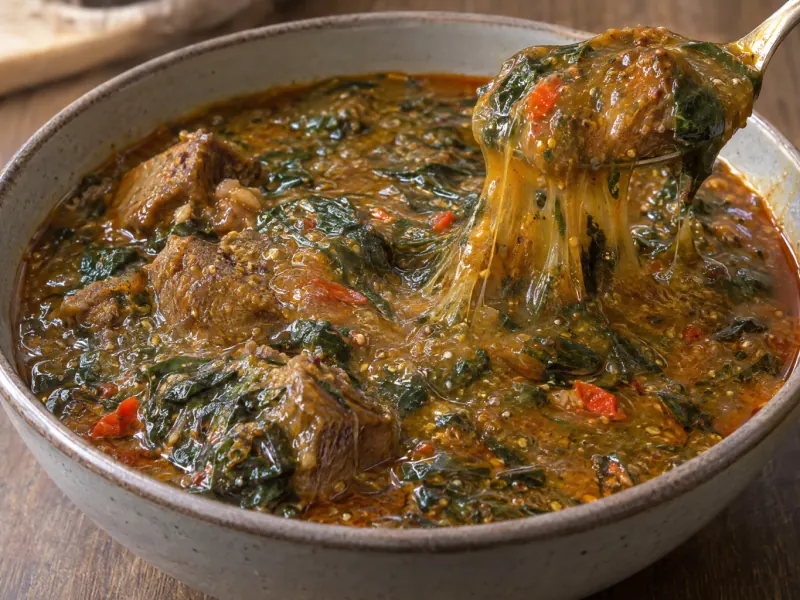
Ogbono soup (ogg-BAW-noh) is a Nigerian soup thickened with ground wild mango seeds, which give the soup its draw: a slick, stretchy texture. Here beef is simmered into a full-bodied stock and the ogbono is loosened in warm palm oil first, so it dissolves without lumps. Serve with a swallow, a soft dough such as eba, fufu, amala or pounded yam.
- Total2 h 15 min
- Servings6
- DifficultyMedium
Ingredients
Method
Season and steam the beef
Put the beef, onion, stock cubes and salt in a large heavy pot of about 4 qt (4 l), stir well, cover and set over medium heat. Let the beef steam in its own juices for 10 minutes, stirring once.
Look for: The beef has turned grey on the outside and released a little cloudy, savoury liquid.
Simmer the stock
Pour in 4 cups (960 ml), bring to the boil, then lower the heat, cover and simmer for 60–90 minutes until the beef is tender. The beef reaches a safe internal temperature of 145 °F (63 °C) long before it is tender, so judge by texture.
Look for: A knife slides into a chunk of beef with little resistance and the meat is brown all the way through.
Check the amount of stock
You want about 4 cups (1 l) of stock around the beef. Top up with some of the remaining water if needed, keep the rest for loosening the soup later, and bring the pot back to a gentle simmer.
Loosen the ogbono in palm oil
In a small pan, warm the palm oil over low heat for 1–2 minutes until just melted and warm, then take it off the heat. Stir in the ground ogbono to make a thick, smooth paste.
Look for: The paste is evenly glossy with no dry pockets of ogbono, and the oil never smokes.
Stir the ogbono into the stock
Add the ogbono paste to the simmering stock a spoonful at a time, stirring steadily after each addition. Keep stirring for 3–4 minutes as it dissolves.
Look for: The soup thickens, turns cloudy and pulls into long strings when lifted with a spoon.
Add crayfish and pepper
Stir in the crayfish and scotch bonnet, turn the heat to low and simmer, partly covered, for 10–15 minutes, stirring and scraping the bottom every couple of minutes. If the soup becomes too thick to stir easily, loosen it with a splash of the remaining water.
Look for: The palm oil has blended into the soup and the draw is long and glossy, with nothing catching on the bottom.
Finish with ugwu and serve
Taste and add a little more salt if needed, then stir in the ugwu and cook for 2–3 minutes. Take the pot off the heat and serve hot with eba, fufu, amala or pounded yam.
Look for: The ugwu has wilted but is still deep green.
Why this works
- Loosening the 100 g of ogbono in warm palm oil coats the particles, so they spread through the stock instead of clumping into dry lumps the moment they hit the hot liquid.
- About 100 g of ogbono to roughly 1 litre of stock gives a draw that clings to a swallow without setting into a rubbery mass. More ogbono or less stock makes it gluey.
- Steaming the beef with onion, stock cubes and salt before any water goes in seasons the meat itself and gives a concentrated stock. Ogbono tastes mild, so the stock carries most of the flavour.
- Once the ogbono is in, low heat and frequent stirring matter because the thickened soup sinks and scorches quickly. A burnt taste spreads through the whole pot.
Common mistakes
- Using stale or rancid ogbono: it should smell mildly nutty, not sour or paint-like. Old ogbono gives a bitter soup with a weak draw, so store it in the freezer and smell it before cooking.
- Leaving the pot on medium-high heat after the ogbono goes in: the bottom scorches within minutes. Keep it on low and scrape the base every couple of minutes.
- Adding the ugwu too early: it turns dark olive and soft. Stir it in only for the last 2–3 minutes.
Swaps
- ugwu (fluted pumpkin) leaves → spinach, bitter leaf or sliced okra. Ugwu is sold fresh or frozen in African grocers. Fresh or thawed frozen spinach (squeezed dry) is the easiest swap. Washed bitter leaf or a handful of sliced okra are common regional choices, and okra adds extra draw.
- boneless beef chuck or stewing beef → goat meat, tripe or cow skin (ponmo), or a mix. Goat needs a similar simmering time. Tripe and cow skin need longer, so start them first and add the beef once they have begun to soften.
- ground dried crayfish → finely ground dried shrimp. Ground dried crayfish is a dried, often smoked powder sold, like ground ogbono, in African and Caribbean grocers and online. If you cannot find it, dried shrimp from Asian grocers gives a similar savoury, shellfish depth; grind it to a powder and use the same amount.
- scotch bonnet pepper → habanero or 1/2 tsp cayenne pepper. Habanero has a similar heat and fruitiness. Cayenne gives heat without the fruity note.
Storage
Cool, then refrigerate in a covered container for up to 3 days, or freeze for up to 3 months. Thaw frozen soup in the fridge. Reheat gently in a pot over low heat with a splash of water, stirring often, until steaming hot all the way through. The soup thickens as it cools, and the greens lose some colour on reheating.
Scaling
To double, use a pot of at least 6 litres so the thick soup has room to be stirred. The beef needs about the same simmering time; add the ogbono paste in two batches and allow a few extra minutes of stirring. To halve, use a pot of about 2–3 litres so the stock is deep enough to stir the ogbono into, and watch closely for scorching.
Make ahead
The beef and stock can be cooked up to 2 days ahead and refrigerated; reheat to a simmer before adding the ogbono. Whole ogbono seeds can be ground in advance and kept in the freezer.
Nutrition per serving
Nutrition is not shown because it could not be calculated reliably from the ingredients.
Contains
- Gluten
- Soy
- Shellfish
- Celery
Derived from the ingredient list. Always check the labels of the products you buy. Allergens and health
Questions
Where do I buy ogbono, and can I use whole seeds?
Ground ogbono and whole seeds are sold in African and Caribbean grocers and online. To use whole seeds, grind them to a fine powder in a dry spice or coffee grinder in short bursts so they do not turn oily, then weigh out the same amount.
Why isn't my ogbono soup drawing?
The usual causes are old ogbono or too much liquid for the amount of ogbono. Simmer the soup uncovered on low for a few more minutes, or stir in a little extra ogbono loosened in palm oil.
Should the palm oil go in before or after the ogbono?
Both methods are common. Some cooks mix the ogbono with warm palm oil first, as here, and others stir the ogbono straight into boiling stock and add the oil afterwards. The oil-first method makes lumps less likely for anyone new to the soup.
Cook next
Published November 20, 2026 · Updated · Published by Recipe Worldwide · How we make recipes