Chin Chin (Nigerian Fried Dough Snack)
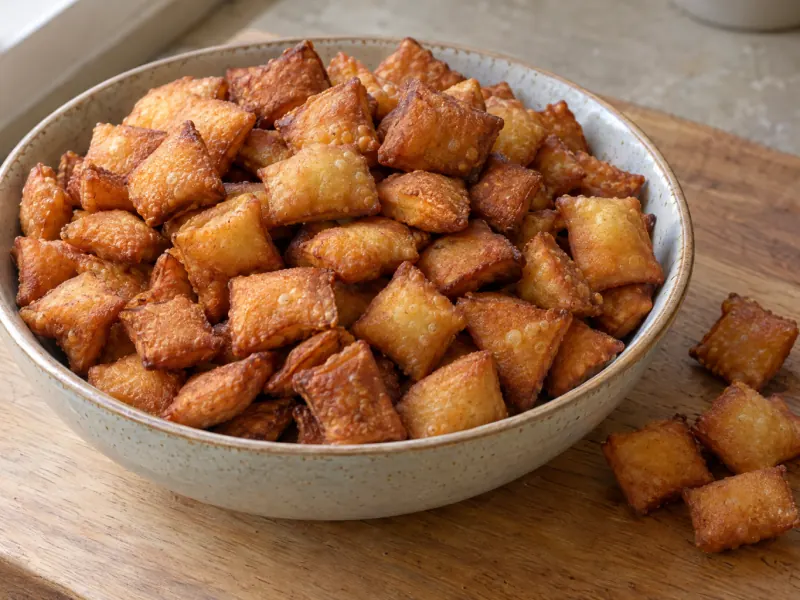
Chin chin is a crunchy Nigerian fried dough snack, lightly sweet and scented with nutmeg. This version rubs cold butter into the flour and adds two eggs and a little baking powder, so the pieces are crisp all the way through but still easy to bite.
- Total2 h 5 min
- Servings12
- DifficultyEasy
Ingredients
Method
Mix the dry ingredients
In a large bowl, whisk together the flour, sugar, baking powder, nutmeg and salt so the nutmeg and baking powder are evenly distributed.
Rub in the butter
Add the cold butter and rub it into the flour with your fingertips until no lumps bigger than a lentil remain.
Look for: The mixture looks like damp sand and holds together when squeezed in your fist.
Bind the dough
Beat the eggs with the milk, keeping back 2¼ tsp (11 ml) of the milk. Pour the egg mixture into the bowl and stir, then press it together into a dough, adding the reserved milk only if dry crumbs remain at the bottom of the bowl.
Look for: A firm dough that does not stick to your hands or the bowl.
Knead and rest
Knead the dough on a clean counter for 2–3 minutes, only until smooth. Wrap it and let it rest for 15 minutes so it rolls out without shrinking back.
Look for: The surface is smooth and springs back slowly when pressed.
Roll and cut
Divide the dough into four pieces. Roll each piece out to about ¼ in (0.6 cm) thick, cut it into strips about ⅔ in (1.5 cm) wide, then cut across the strips to make small squares. Spread the squares out on a tray and separate any that stick together.
Heat the oil
Pour the oil into a deep, heavy pot at least 9½ in (24 cm) wide, filling it no more than halfway, and heat it to 340 °F (170 °C). Keep the pot on a back burner and never leave hot oil unattended.
Look for: A test square sinks briefly, then rises and bubbles steadily.
Fry in batches
Fry the squares in six to eight small batches, adding only enough to float in a loose single layer, for 4–5 minutes each, stirring often with a slotted spoon so they colour evenly. Let the oil come back to 340 °F (170 °C) before adding the next batch.
Look for: Evenly deep golden brown, and the bubbling around the pieces has slowed.
Drain and cool
Lift the chin chin onto a rack or a tray lined with kitchen paper and spread it out in a single layer. Let it cool completely before storing it in an airtight container.
Look for: A cooled piece snaps cleanly and is dry, not doughy, in the centre.
Why this works
- Rubbing cold butter into the flour coats it with fat before the egg and milk go in, which limits gluten and gives a short, crisp bite instead of a chewy one.
- Two eggs and a single teaspoon of baking powder for 500 g of flour keep the pieces crunchy but not rock-hard; leaving both out gives the very hard style some cooks prefer.
- A moderate oil temperature lets the centre of each square cook through before the sugar in the dough browns the outside; hotter oil gives dark pieces that stay soft inside.
- Cutting every square to the same small size means a whole batch finishes at the same moment, so no pieces are left pale or burnt.
Common mistakes
- Adding all the milk at once can make a sticky dough that needs extra flour and fries up tough; keep some back and add it only if dry crumbs remain.
- Crowding the pot drops the oil temperature, so the pieces absorb oil and turn greasy; fry in batches and let the oil recover between them.
- Sealing chin chin in a jar while still warm traps steam and softens it; let it cool completely first.
Swaps
- Unsalted butter → baking margarine (block, not spread). Common in Nigeria and gives a similar crisp result.
- Whole milk → evaporated milk. Use the same amount; it gives a slightly richer flavour and a little more colour when fried.
- Ground nutmeg → ground cinnamon or finely grated orange zest. Use the same amount of cinnamon, or the zest of one orange.
- Large eggs → no eggs, plus a little extra milk. Add milk a spoonful at a time until the dough comes together; the result is harder and crunchier.
Storage
Store fully cooled chin chin in an airtight container at room temperature for up to 3 weeks; it does not need the fridge. If it softens, spread it on a tray, warm it in a low oven (150°C / 300°F) for 5 minutes and let it cool again to re-crisp.
Scaling
To double, mix the dough in one large bowl but fry in twice as many small batches rather than crowding the pot; the time per batch stays the same. To halve, use one egg and keep the oil at least a few centimetres deep.
Make ahead
The dough can be wrapped and refrigerated for up to 1 day; let it stand at room temperature for 20 minutes before rolling so it does not crack. Because fried chin chin keeps well in a sealed container, it can be made several days before a party.
Nutrition per serving
Nutrition is not shown because it could not be calculated reliably from the ingredients.
Contains
- Gluten
- Milk
- Egg
- Soy
Derived from the ingredient list. Always check the labels of the products you buy. Allergens and health
Questions
Why is my chin chin soft instead of crunchy?
Usually the pieces came out of the oil too pale or were cut too thick, so moisture stayed in the centre. Fry until deep golden, keep the dough thin, and remember the pieces crisp further as they cool.
Can I bake chin chin instead of frying it?
Yes. Spread the squares on a lined baking sheet and bake at 180°C (350°F) for 15–20 minutes, turning once, until golden; baked chin chin is drier and less rich than fried.
How do I check the oil without a thermometer?
Drop in one square of dough: it should sink for a moment, then rise and bubble steadily. If it browns within a minute the oil is too hot; if it sits on the bottom without bubbling, it is too cool.
Cook next


Published November 24, 2026 · Updated · Published by Recipe Worldwide · How we make recipes