Melktert (South African Milk Tart)
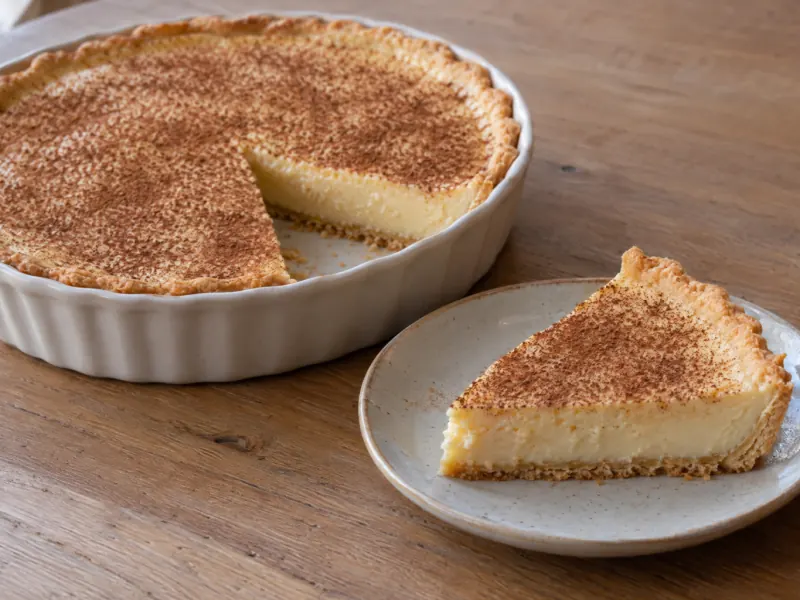
Melktert (MELK-tairt), Afrikaans for milk tart, is a South African custard tart: a sweet shortcrust case filled with a soft, milky custard and dusted with cinnamon. This version cooks the custard on the stove with flour and cornstarch, then sets it in a fully baked crust in the fridge, so the filling slices cleanly and the base does not go soggy.
- Total6 h 50 min
- Servings8
- DifficultyMedium
Ingredients
Pastry
Custard
Topping
Method
Cream the pastry base
Beat the softened butter and the sugar with a hand or stand mixer (or a wooden spoon) until pale and creamy, 2–3 minutes. Beat in the egg until fully combined.
Look for: The butter and sugar turn pale and fluffy; after the egg goes in, a slightly curdled look is fine and smooths out once the flour is added.
Make the dough
Add the flour and ¼ tsp of the salt and mix on low speed, or stir with a spatula, just until a soft dough forms. Flatten it into a disc, wrap it and chill for 30 minutes.
Look for: No dry flour remains and the dough holds together when pressed.
Line the dish
Roll the dough out between two sheets of parchment paper into an even round about 12 in (30 cm) across. Line a deep 9 in (23 cm) pie dish or tart tin (at least 1½ in (4 cm) deep), pressing the pastry into the corners and up the sides, and trim the overhang level with the rim. Prick the base with a fork and chill for 15 minutes while the oven heats to 375 °F (190 °C).
Look for: The pastry is even in thickness, with no thick ridge where the base meets the sides.
Blind-bake the crust
Line the pastry with parchment paper, fill it with pie weights or dried beans and bake at 375 °F (190 °C) for 15 minutes. Lift out the paper and weights and bake for another 10–12 minutes, then let the crust cool in the dish for about 30 minutes while you make the custard.
Look for: The base looks dry and the whole crust is evenly golden, not pale.
Heat the milk
Heat the milk and the butter for the custard in a medium saucepan over medium heat until the butter melts and small bubbles form around the edge.
Look for: Steam rises and tiny bubbles appear at the edge; it is not at a rolling boil.
Mix the thickening paste
In a bowl, whisk the eggs, the sugar for the custard, the flour for the custard, the cornstarch and the rest of the salt into a smooth, thick paste.
Look for: No lumps of flour or cornstarch remain.
Temper the eggs
Whisking all the time, pour about a third of the hot milk into the egg paste in a thin stream. Pour this mixture back into the saucepan with the rest of the milk and whisk to combine.
Look for: The mixture is smooth and evenly warm, with no specks of cooked egg.
Cook the custard
Cook over medium-low heat, whisking constantly and reaching into the corners of the pan, until the custard thickens and starts to bubble, 4–6 minutes. Let it bubble gently for 1 more minute, still whisking, then take it off the heat and whisk in the vanilla.
Look for: The custard coats the back of a spoon thickly and a line drawn through it holds its shape.
Fill the crust
Pour the hot custard into the crust and smooth the top with a spatula. If there is custard left over, pour it into a small ramekin and chill it with the tart. Leave the tart at room temperature for 30 minutes.
Look for: The surface is level and has stopped steaming.
Chill until set
Cover the tart loosely and refrigerate for at least 4 hours, or overnight.
Look for: The center no longer wobbles when the dish is nudged and the filling feels firm to a light touch.
Dust and slice
Just before serving, sift the cinnamon evenly over the top. Slice with a knife dipped in hot water and wiped dry between cuts.
Look for: The cut sides are clean and the custard holds its shape on the plate.
Why this works
- Flour and cornstarch work together: the cornstarch gives a clean, sliceable set, while the flour keeps the filling soft and creamy rather than jelly-like.
- The custard has to bubble for a full minute after it thickens: cornstarch only reaches its full thickening power near the boil, the extra minute cooks out the raw flour taste, and boiling destroys an enzyme in egg yolk that would otherwise break down the starch and thin the filling overnight.
- With 700 ml of milk to only 2 eggs, the filling tastes of milk rather than egg; the starches, not the eggs, do most of the setting.
- The filling is never baked, so the crust must be baked until golden and dry before it is filled; an underbaked base turns soggy under the custard in the fridge. The base is crispest on the first day.
Common mistakes
- Lumpy custard: whisk constantly and scrape the corners of the pan while it thickens. If lumps form anyway, push the custard through a fine sieve before pouring it into the crust.
- Runny filling: the custard was taken off the heat before it bubbled, or the tart was cut too soon. Cook it until it bubbles for a full minute and chill for at least 4 hours.
- Shrunken or soggy crust: chill the lined dish before baking and bake the crust until it is evenly golden, not pale.
Swaps
- all-purpose (plain) flour → Biscuit-crumb base. Replaces all the pastry ingredients: crush 200 g Marie biscuits, Rich Tea biscuits or graham crackers, mix with 80 g melted butter, press into the dish and chill for 30 minutes; skip the blind-baking.
- cornstarch (cornflour) → All-purpose flour. Use 55 g flour in total for the custard and no cornstarch, as in older recipes; the filling sets a little softer and less glossy.
- vanilla extract → Cinnamon stick. Heat the milk with a cinnamon stick, leave it to infuse for 10 minutes off the heat, remove the stick, then bring the milk back to a simmer before tempering the eggs.
- whole milk → Semi-skimmed (2%) milk. The custard still sets, but it tastes less rich.
Storage
Keep the tart covered in the fridge for up to 3 days and serve it cold or after 15 minutes at room temperature. Do not freeze it: the cornstarch custard weeps and turns spongy when thawed, and the crust softens.
Scaling
To double, make two tarts in two deep 23 cm dishes and cook the custard in a larger saucepan; it takes a few minutes longer to thicken. To halve, use one egg in the custard and make 4–5 tartlets of about 10 cm: bake them with weights for 8 minutes, then without for 6–8 minutes until golden.
Make ahead
The pastry dough keeps for 2 days in the fridge or 1 month in the freezer, and the baked crust keeps for 1 day in an airtight container. The whole tart can be made a day ahead; dust it with cinnamon just before serving.
Nutrition per serving
- Calories
- 380 kcal
- Protein
- 8 g
- Carbohydrates
- 47 g
- Sugars
- 23 g
- Fibre
- 1 g
- Fat
- 18 g
- Saturated fat
- 10.5 g
- Sodium
- 105 mg
Estimated from the raw ingredients using USDA FoodData Central values; actual values vary with brands and portion size.
Contains
- Gluten
- Milk
- Egg
Derived from the ingredient list. Always check the labels of the products you buy. Allergens and health
Questions
Why is my melktert runny?
Usually the custard came off the heat before it bubbled for a full minute, so the cornstarch did not thicken fully, or the tart was sliced before it had chilled for 4 hours.
Can I use puff pastry instead of shortcrust?
Yes, store-bought puff pastry is a common shortcut. Blind-bake it until deep golden and press the puffed base down gently before filling.
Is melktert always made with a stovetop custard?
No. Some traditional recipes pour the custard into the pastry and bake it in the oven. This version cooks the custard on the stove and sets it in the fridge, which gives a smooth, even filling over a fully baked base.
Cook next

Published November 25, 2026 · Updated · Published by Recipe Worldwide · How we make recipes