Turkish Rice Pudding (Sütlaç), Oven-Browned
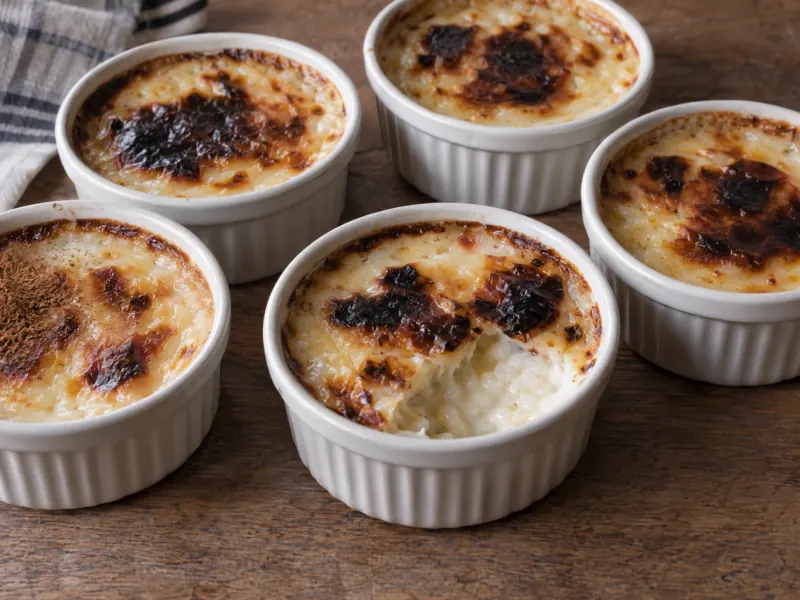
Fırın sütlaç (fuh-RUHN soot-LAHCH) is Turkish rice pudding baked in individual dishes until the top blisters dark brown, then served cold. This version cooks the rice in water first, thickens the milk with rice flour for a soft, spoonable set, and bakes the dishes in a tray of cold water so only the surface browns.
- Total4 h 40 min
- Servings6
- DifficultyEasy
Ingredients
Method
Rinse the rice
Put the rice in a sieve and rinse under cold running water, rubbing the grains lightly with your fingers. Drain well.
Look for: The water running off is only faintly cloudy.
Cook the rice in water
Tip the rice into a heavy-based saucepan with the water and bring to the boil. Lower the heat and simmer, partly covered and stirring now and then, for 15–20 minutes.
Look for: A grain crushes easily between your fingers and only a little starchy water is left in the pan.
Heat the oven, add milk and sugar
Heat the oven to 450 °F (230 °C) with a rack in the upper third; the browning works best on a conventional (top and bottom heat) setting rather than fan. Pour 3¾ cups (880 ml) into the rice and add the sugar and salt. Bring back to a gentle simmer over medium-low heat and cook for about 15 minutes, scraping the bottom of the pan with a wooden spoon every minute or two.
Look for: Small bubbles at the edge, the rice very soft and the milk slightly thickened and ivory-coloured.
Make the slurry
Whisk the rice flour into the remaining cold milk in a jug until completely smooth.
Look for: No dry lumps of rice flour remain.
Thicken the pudding
Whisk the slurry of rice flour and milk again and pour it into the pan in a thin stream, stirring constantly. Keep stirring at a gentle simmer for 5–8 minutes, then take off the heat and stir in the vanilla, if using.
Look for: The pudding coats the back of the spoon thickly but still pours; it sets much firmer as it chills.
Fill the dishes
Ladle the pudding into six ovenproof ramekins or small clay dishes of ¾ cup (200 ml)–1 cup (250 ml) each, sharing the rice evenly and leaving about ⅓ in (1 cm) headspace so it does not bubble over. Stand them in a deep roasting tin and pour in about 3¼ cups (750 ml) cold water so it comes roughly halfway up the sides.
Brown the tops
Bake on the upper rack at 450 °F (230 °C) for 15–20 minutes; with a fan oven, start checking after 12 minutes, as the tops can dry out before they colour. If the tops are still pale after 20 minutes, switch to the grill (broiler) and watch closely for 2–4 minutes.
Look for: The surface is blistered with patches of deep brown to almost black, while the pudding underneath still wobbles.
Cool and chill
Carefully take the tin out of the oven, then lift the hot dishes out of the water with tongs or an oven glove. Leave them to cool at room temperature for about 30 minutes, refrigerate for at least 3 hours, then serve cold, dusted with a little cinnamon if you like.
Look for: The pudding is cold right through and holds a spoon-shaped hollow.
Why this works
- Cooking the rice in water first softens the grains fully before the milk goes in, so the milk only needs about 15 minutes on the heat and has less chance to catch on the bottom of the pan.
- 30 g rice flour to 1 litre of milk gives a soft, spoonable set once chilled; more flour turns the pudding stiff and pasty.
- The cold water in the roasting tin keeps the pudding from boiling up and splitting in the hot oven, so only the surface browns.
- A hot oven at 230°C with the dishes high up is what blisters the milk skin; a cooler oven just dries the top without colouring it.
Common mistakes
- Scorching: use a heavy-based pan and scrape the bottom every minute or two once the milk is in; if it does catch, pour the pudding into a clean pan without scraping up the burnt layer.
- Lumps: always mix the rice flour into cold milk, never straight into the hot pan, and pour the slurry in slowly while stirring.
- Over-thickening on the hob (stovetop): take it off the heat while it still pours, because it firms up a lot in the fridge.
Swaps
- rice flour → cornstarch (cornflour). Use the same weight; it gives a slightly glossier, smoother set.
- short-grain white rice (pudding rice or arborio) → UK pudding rice, arborio or Calrose. Turkish shops use baldo or osmancık rice; any starchy short-grain rice works the same way. Avoid basmati or long-grain, which stays separate.
- vanilla extract → a strip of lemon zest or a little rose water. Simmer the lemon zest with the milk and remove it before thickening; add rose water off the heat, about 1 tsp.
Storage
Cover each dish with cling film (plastic wrap) and keep in the fridge for up to 3 days. It is served cold, so there is no reheating; freezing is not recommended because the pudding turns grainy and weeps when thawed.
Scaling
To double, use a wide, heavy pot so the milk heats evenly, allow a few extra minutes for it to come to a simmer, and bake in two roasting tins on two racks, swapping halfway. To halve, use a small pan and keep an eye on the rice, as the water evaporates faster and may need a splash more.
Make ahead
Make it up to a day ahead; the texture is at its best after an overnight chill.
Nutrition per serving
- Calories
- 290 kcal
- Protein
- 7 g
- Carbohydrates
- 52 g
- Sugars
- 34 g
- Fibre
- 1 g
- Fat
- 6 g
- Saturated fat
- 3.7 g
- Sodium
- 40 mg
Estimated from the raw ingredients using USDA FoodData Central values; actual values vary with brands and portion size.
Contains
- Milk
Derived from the ingredient list. Always check the labels of the products you buy. Allergens and health
Questions
Why didn't the top go brown?
The oven was not hot enough, was on a fan setting, or the dishes sat too low. Finish under a hot grill (broiler) for a few minutes, watching closely, until dark patches appear.
Can I skip the baking?
Yes. Without the oven step it is plain sütlaç: chill it the same way and serve it dusted with ground cinnamon.
Why is my pudding runny after chilling?
The slurry was not cooked long enough to thicken, or the pudding boiled too hard in the oven. Next time let it simmer the full 5–8 minutes after adding the rice flour and make sure the tin has cold water in it.
Cook next

Published November 20, 2026 · Updated · Published by Recipe Worldwide · How we make recipes