Bunny Chow
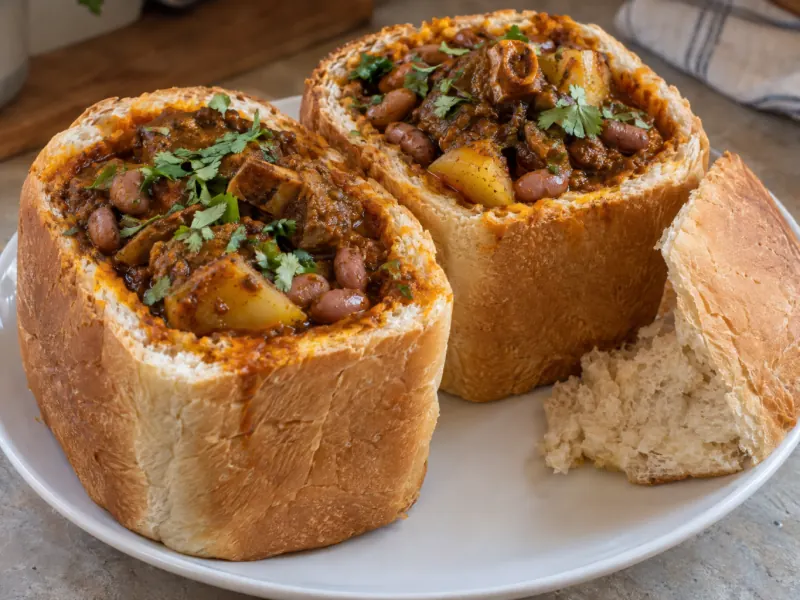
Bunny chow (BUN-ee chow) is Durban curry served inside a hollowed-out loaf of unsliced white bread. This version fills the bread with a mutton and sugar bean curry. The curry is reduced until the gravy soaks into the walls without leaking through the base, and sandwich loaves are halved so every portion stands on a crust.
- Total2 h 40 min
- Servings4
- DifficultyMedium
Ingredients
curry
to serve
Method
Bloom the whole spices
Heat the oil over medium heat in a heavy pot about 9½ in (24 cm) wide. Add the cinnamon, star anise, cardamom and fennel seeds, then the curry leaves after 30 seconds, standing back because they spit.
Look for: The fennel seeds sizzle and smell sweet, and the curry leaves turn glossy and crisp.
Brown the onions
Add the onion and cook, stirring often, for 10–12 minutes. Lower the heat if the edges darken before the centre softens.
Look for: The onion is soft and an even deep golden brown.
Add aromatics and ground spices
Stir in the garlic, ginger and chillies and cook for 1 minute. Add the masala, turmeric, cumin and ground coriander along with 2½ tbsp (40 ml) of the water, and stir for 1 minute so the spices cook without scorching.
Look for: A thick, dark red paste that smells toasted, not raw.
Cook down the tomatoes
Add the tomatoes and salt. Cook, stirring and scraping the base, for 8–10 minutes.
Look for: The sauce is jammy and oil pools at the edges.
Coat the mutton
Add the mutton and turn it in the masala over medium-high heat for about 5 minutes.
Look for: No raw pink surfaces remain and every piece is coated red.
Simmer covered
Pour in the remaining 1½ cups (360 ml) of the water, bring to the boil, then cover and simmer gently on low for 1 hour, stirring now and then. If the mutton is still firm, simmer covered for another 15–30 minutes before adding the potatoes.
Look for: A fork goes into the meat with only slight resistance.
Add the potatoes
Stir in the potatoes, cover and simmer for 25 minutes more, adding a splash of hot water if the base catches. The mutton is done when the meat pulls easily from the bone; at that stage it is far beyond the safe minimum of 145 °F (63 °C). If it still clings, keep simmering covered until it does.
Look for: The potatoes are tender to a knife and the mutton pulls easily from the bone.
Thicken with beans
Add the sugar beans and garam masala and simmer uncovered for about 10 minutes, stirring gently so the potatoes stay whole. Fish out the whole spices as they surface. Taste and add more salt to taste.
Look for: The gravy coats the back of a spoon and leaves a clear trail when a finger is drawn through it.
Rest the curry and cut the bread
Take the pot off the heat and let the curry rest for 10 minutes. Meanwhile, halve each of the loaves crosswise and stand each half on its crusty end. Cut a square into the soft crumb, leaving walls about ⅓ in (1 cm) thick. Lift out the plug of bread (the 'virgin'), then scoop out more crumb, leaving a base of about ⅔ in (1.5 cm).
Look for: The hollows are deep and even, and the walls and base are firm when pressed.
Fill and serve
Ladle the curry into the bread hollows, piling in meat, potatoes and plenty of gravy. Scatter over the coriander, set the virgin on top as a lid and serve with the scooped-out crumb for dipping. Serve any curry that does not fit in a bowl on the side.
Look for: The gravy darkens the inside walls without seeping through the base.
Why this works
- Halving two sandwich loaves gives four half bunnies that each stand on a crust end. Cutting one loaf into quarters leaves two middle pieces with no bottom crust, which is the 'funny bunny' that leaks.
- The gravy is reduced after the sugar beans go in because loose gravy soaks straight through the bread. It should coat a spoon before filling.
- Cooking the grated tomatoes until the oil separates removes their raw acidity and gives the gravy body before the 400 ml of water goes in.
- Bone-in shoulder or neck needs at least 1½ hours; allow up to 30 minutes extra for older mutton, which brings the total time to about 3 hours. The bones and connective tissue enrich the gravy and keep the meat moist.
Common mistakes
- Filling the bread with thin gravy makes the base collapse. Simmer uncovered until the gravy is thick, and leave a base of about 1.5 cm.
- Scooping the walls too thin makes the bunny split when picked up. Leave about 1 cm of crumb all round.
- Using a very hot curry powder at full quantity can make the curry too fiery. Taste the masala first and start with 1 tbsp if it is strong.
Swaps
- bone-in mutton (shoulder or neck), from halal butchers or South Asian grocers, or lamb (see substitutes) → bone-in lamb shoulder or neck, or beef chuck. Lamb is easier to find outside South Africa and may be tender about 15 minutes sooner. Beef chuck needs the same time or slightly longer.
- canned sugar beans → canned borlotti (cranberry) beans. Sugar beans are hard to find outside South Africa. Borlotti beans have the same speckled skin and creamy texture.
- Durban masala or hot curry powder → medium curry powder plus 1 tsp hot chilli powder. Durban masala is sold in South African and Indian grocers. This mix gives a similar red colour and heat. Some masala blends contain mustard, so check the label if that matters.
- unsliced white sandwich or tin loaves (about 450 g each, from the bakery section) → 4 small unsliced white loaves (about 350 g each), halved. Gives smaller portions closer to a quarter bunny, so expect curry left over to serve on the side. Commercial loaves can contain milk or soy depending on the brand, so check the label.
Storage
Cool quickly, ideally within 2 hours, by spreading the curry in a shallow container before refrigerating. Keep the curry, not filled bunnies, covered in the fridge for up to 3 days, or freeze it for up to 3 months. The potatoes turn slightly grainy after freezing. Reheat in a pan with a splash of water until steaming hot all the way through, then fill freshly cut bread.
Scaling
To double the recipe, use a pot of about 28–30 cm and add the extra water gradually. The reduction stage with the beans may take 5–10 minutes longer. To halve it, use a pot of about 20 cm and halve all ingredients. Cooking times stay about the same, but check the liquid more often, because a smaller volume can catch on the base. Allow one sandwich loaf for every two portions.
Make ahead
Make the curry up to 2 days ahead. It thickens and deepens overnight, so loosen it with a little water when reheating. Cut and hollow the bread just before serving so it does not dry out.
Nutrition per serving
- Calories
- 1105 kcal
- Protein
- 67 g
- Carbohydrates
- 147 g
- Sugars
- 18 g
- Fibre
- 15 g
- Fat
- 28 g
- Saturated fat
- 5.6 g
- Sodium
- 2255 mg
Estimated from the raw ingredients using USDA FoodData Central values; actual values vary with brands and portion size.
Contains
- Gluten
- Milk
- Soy
- Mustard
Derived from the ingredient list. Always check the labels of the products you buy. Allergens and health
Questions
Why halve whole loaves instead of cutting one loaf into quarters?
Each half loaf has a crust at one end to stand on, so it holds the gravy. The middle quarters of a loaf have no bottom crust and tend to leak.
Can bunny chow be made with chicken or just beans?
Yes, chicken, beef and bean curries are all common fillings. For chicken, use bone-in thighs and simmer for about 35 minutes until they reach 74 °C. For an all-bean version, use two cans of beans, reduce the water to about 250 ml, add the potatoes with the water and simmer about 25 minutes, then add the beans and reduce.
What is the 'virgin'?
It is the plug of bread cut from the centre of the loaf. It goes back on top as a lid and is usually torn up and dipped into the curry while eating.
Cook next

Published November 20, 2026 · Updated · Published by Recipe Worldwide · How we make recipes