DessertsAfghan
Firni (Afghan Cardamom Milk Pudding)
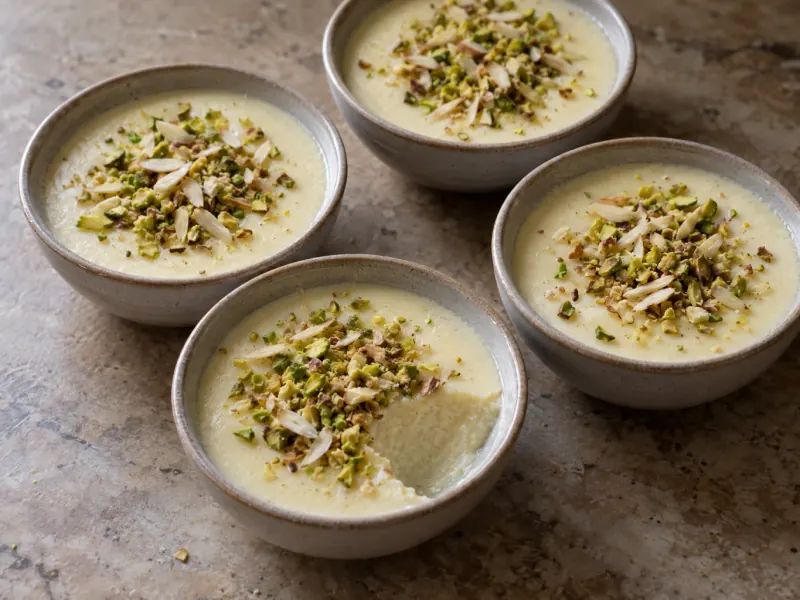
Firni (FEER-nee) is the Afghan milk pudding served at weddings and Eid, set with cornflour and scented with cardamom and rosewater. Simmering the pudding for a couple of minutes after it thickens gives a clean, soft set that spoons like custard.
- Total3 h 55 min
- Servings6
- DifficultyEasy
Ingredients
Method
Make the cornflour slurry
In a bowl, whisk the cornflour into 1 cup (250 ml) of the cold milk until no dry pockets remain. Set it next to the stove.
Look for: The slurry is smooth and pourable, like single (light) cream, with no lumps.
Heat the milk with the sugar
Pour the remaining 3¼ cups (750 ml) of the milk into a heavy-based (heavy-bottomed) saucepan, add the sugar and heat over medium, stirring to dissolve the sugar.
Look for: The milk is steaming with small bubbles around the edge but not yet at a rolling boil.
Thicken with the cornflour
Whisk the slurry again, since the cornflour settles quickly, then pour it into the hot milk in a thin stream while whisking constantly. Turn the heat to medium-low and keep stirring, scraping the base and corners of the pan with a spatula.
Look for: The mixture turns from milky to glossy and thick enough to coat the back of a spoon, then starts to bubble slowly.
Add cardamom and simmer
Stir in the cardamom and let the pudding simmer gently for 2–3 minutes, stirring the whole time so it does not catch on the bottom. In the last minute, stir in the rosewater if using.
Look for: Heavy, slow bubbles break the surface and a line drawn through the pudding with the spatula holds for a second; it no longer tastes floury.
Pour into bowls
Pour the hot pudding straight away into six small bowls holding about ¾ cup (200 ml) each, or one shallow dish about 8 in (20 cm) across, and tap them on the counter to level the surface.
Look for: The surface is smooth and level.
Garnish
Scatter the pistachios and the almonds, if using, over the warm pudding so they stick to the surface as it sets.
Cool and chill
Leave the bowls at room temperature for about 30 minutes, then cover and refrigerate for at least 3 hours. Serve the firni cold.
Look for: The pudding is cold and set; it holds its shape on a spoon and wobbles slightly when the bowl is tilted.
Why this works
- 60 g cornflour to 1 litre (about 4 cups) of whole milk gives a pudding that sets softly in a bowl; much more and it turns rubbery, much less and it stays pourable.
- Mixing the cornflour with cold milk first separates the starch grains, so they swell evenly in the hot milk instead of clumping into lumps.
- Cornflour only reaches full thickness once it has bubbled for a couple of minutes; stopping as soon as the mixture looks thick leaves a floury taste and a softer set.
- Rosewater goes in at the end because its aroma fades with longer boiling.
Common mistakes
- Lumps: pouring the slurry in all at once without whisking, or leaving it to settle in the bowl. Re-whisk the slurry and add it in a thin stream while whisking; if lumps form anyway, push the hot pudding through a sieve before pouring it into bowls.
- Scorched taste: milk and starch catch quickly on the bottom of the pan. Use a heavy-based (heavy-bottomed) pan, keep the heat at medium-low once the slurry is in, and scrape the base constantly.
- Too much rosewater makes the pudding taste soapy. Start with the listed tablespoon; brands vary in strength.
Swaps
- cornflour (cornstarch) → rice flour, about 70 g. Gives the slightly grainier texture of South Asian phirni and Iranian fereni. It needs about 5 minutes more stirring after it thickens.
- whole milk → semi-skimmed (2%) milk. Works, but the pudding is less creamy and sets a little softer.
- rosewater → a pinch of saffron threads soaked in a tablespoon of warm milk. Add it with the cardamom. You can also leave out the rosewater entirely; some Afghan recipes use cardamom alone.
- slivered almonds → pomegranate seeds. Scatter them on just before serving so their juice does not bleed into the pudding.
Storage
Cover and refrigerate for up to 3 days. Do not freeze: cornflour puddings turn watery and spongy when thawed. Serve straight from the fridge; it is not reheated.
Scaling
To double, use a pan large enough that the milk comes no more than halfway up the sides, and allow a few extra minutes for the milk to heat and the pudding to thicken. Halving works in a small saucepan; the pudding thickens a little faster. Chilling time stays about the same if you use individual bowls, but a single deep dish needs longer.
Make ahead
Make the firni up to 2 days ahead and keep it covered in the fridge. For the crunchiest topping, add the nuts on the day you serve it.
Nutrition per serving
- Calories
- 250 kcal
- Protein
- 7 g
- Carbohydrates
- 36 g
- Sugars
- 25 g
- Fibre
- 1 g
- Fat
- 10 g
- Saturated fat
- 4.1 g
- Sodium
- 5 mg
Estimated from the raw ingredients using USDA FoodData Central values; actual values vary with brands and portion size. A small amount of a flavouring without reliable nutrition data is not included.
Contains
- Milk
- Tree nuts
Derived from the ingredient list. Always check the labels of the products you buy. Allergens and health
Questions
Why didn't my firni set?
Usually the pudding was not simmered long enough after it thickened, so the cornflour never reached full strength. Make sure it bubbles slowly for 2–3 minutes while you stir, and chill it for at least 3 hours.
How do I stop a skin forming?
Garnishing the warm surface and covering the bowls once they have cooled slightly helps. For a completely smooth top, press cling film (plastic wrap) directly onto the surface before chilling and add the nuts at serving time.
Can I use rice flour instead of cornflour?
Yes, use about 70 g and cook it about 5 minutes longer after it thickens. The texture is slightly grainier and closer to South Asian phirni.
Cook next

Published November 20, 2026 · Updated · Published by Recipe Worldwide · How we make recipes