Pączki (Polish Doughnuts)
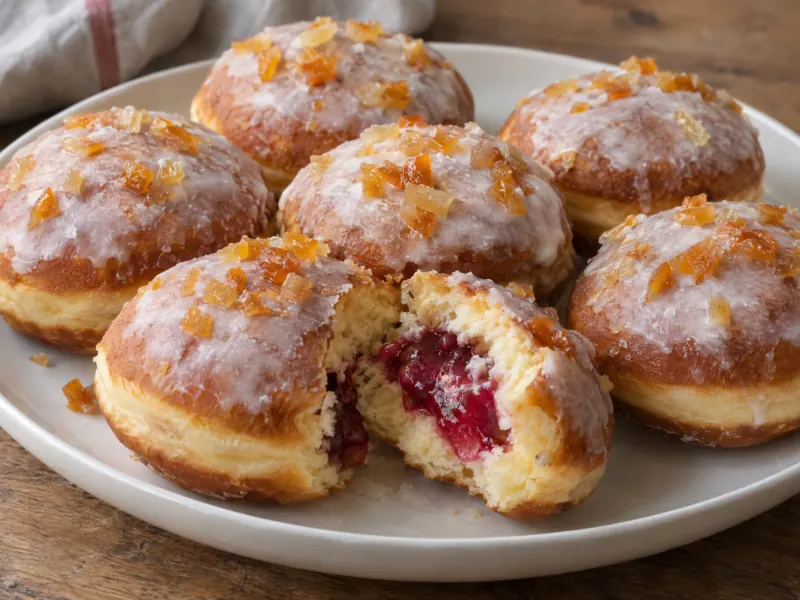
Pączki (POHNCH-kee) are Polish doughnuts made from a rich egg, butter and milk dough, fried in lard and filled with jam. This version fries them plain and pipes the rose petal and plum jam in afterwards, so no seams split in the hot fat. Well-risen dough floats high in the fat, leaving the classic pale ring around the middle.
- Total3 h 50 min
- Servings16
- DifficultyMedium
Ingredients
dough
frying
filling and glaze
Method
Start the sponge
Pour ½ cup (120 ml) of the lukewarm milk into a bowl. It should feel barely warm on your wrist. Stir in the yeast, 1 tbsp (12 g) of the sugar and ⅓ cup (50 g) of the flour, then cover and leave until foamy.
Look for: The surface is domed and covered in bubbles.
Beat the eggs
Melt the butter and set it aside to cool. Whisk the egg yolks, whole egg and remaining sugar until thick and pale.
Look for: The mixture is pale yellow and falls from the whisk in a thick ribbon.
Mix and knead
Put the remaining flour and the salt in a large bowl or stand mixer. Add the sponge, the beaten whole egg and egg yolks and the remaining milk, then knead for 8–10 minutes until smooth and elastic.
Look for: The dough slaps against the bowl and starts to come away from the sides.
Work in the butter
Add the cooled melted butter a spoonful at a time, kneading until each addition is absorbed. Then knead for 5 more minutes. The dough stays soft and slightly tacky, so resist adding more flour.
Look for: The dough is glossy and stretches thin without tearing straight away.
First rise
Cover the bowl and leave the dough in a warm, draught-free place until doubled in size.
Look for: The dough has doubled, and a floured fingertip pressed into it leaves a dent that stays.
Shape the balls
Turn the dough out onto a surface lightly dusted with the dusting flour and divide it into 16 equal pieces. Roll each piece into a tight ball, then flatten it slightly to about ¾ in (2 cm) thick. Space them well apart on a floured tray and cover loosely with a cloth.
Look for: The balls have smooth, taut tops with no visible seams.
Second rise and start the lard
Leave the shaped pączki to rise until puffy. Put the lard in a wide, heavy pot about 9½ in (24 cm) across; once melted it should be at least 1½ in (4 cm) deep. About halfway through the rise, after roughly 15 minutes, set the pot over medium-low heat so the lard starts to melt gently.
Look for: The pączki are about half as large again and feel airy, and a gentle poke springs back slowly.
Heat the lard
Once the lard has fully melted, raise the heat to medium and bring it to 340 °F (170 °C), checking with a thermometer. Melting and heating take about 20–25 minutes in all, so the lard should be ready just as the pączki finish rising.
Look for: A scrap of dough dropped in rises at once and bubbles steadily without browning fast.
Fry
Lower 3 or 4 pączki into the lard top side down and fry for about 2 minutes, until deep golden, then turn them and fry for 1½–2 minutes more. Adjust the heat between batches to keep the lard at 340 °F (170 °C). Cut the first one open to check the centre; if it looks doughy, fry the rest 30 seconds longer per side, or lower the heat slightly so they colour more slowly.
Look for: Both sides are deep golden with a pale ring around the middle, and the test one is fully set and springy inside.
Drain and cool
Lift the pączki out with a slotted spoon onto a wire rack set over kitchen paper (paper towels). Leave them to cool until they are just warm.
Look for: They are comfortable to hold, and the crust feels firm rather than soft and greasy.
Fill
Push a chopstick into the side of each pączek and wiggle it to open a pocket. Stir the rose petal jam and the plum jam separately until smooth, spoon each into a piping bag with a plain nozzle, and fill half the pączki with each.
Look for: Each pączek feels noticeably heavier, and a little jam shows at the opening.
Glaze
Whisk the icing sugar with the hot water until thick but pourable. Dip the top of each pączek into the glaze, scatter with the orange peel and leave until set.
Look for: The glaze turns from glossy to a thin, matt white shell that no longer feels sticky.
Why this works
- Four egg yolks plus one whole egg give the tender, cake-like crumb that sets pączki apart from plain bread doughnuts. The yolk fat softens the gluten, and the white of the whole egg adds lift.
- The butter goes in only after the gluten has formed. Fat added at the start coats the flour and stops the dough from building the structure it needs to hold its shape in the lard.
- A steady {{y:170}} matters. Hotter lard browns the outside before the thick centre cooks, and cooler lard lets the dough soak up fat and turn heavy.
- A well-risen pączek floats high in the lard, so the waistline never touches the fat. That is what forms the pale ring around the middle.
Common mistakes
- Over-proofing the shaped balls makes them collapse when they hit the lard and soak up fat. Start melting the lard halfway through the second rise so it is hot in time, and fry when a gentle poke springs back slowly, not when the dent stays.
- Frying too many at once drops the lard temperature and gives greasy, pale pączki. Fry 3 or 4 per batch and let the lard come back to temperature before the next batch.
- Filling them while hot makes the jam run straight out and turns the crumb soggy. Wait until they are just warm.
Swaps
- lard → sunflower, canola or other neutral vegetable oil. Fry at the same temperature. The crust is a little less crisp, and the taste is milder.
- rose petal jam → raspberry jam with a few drops of rose water. Rose petal jam is sold in Polish and Eastern European delis and online. Use this mix if you cannot find it.
- plum jam (powidła) → thick plum jam or puréed stewed prunes. Powidła is very thick. If your jam is runny, simmer it for a few minutes to reduce it so it does not leak.
- instant dried yeast → 21 g fresh yeast or 9 g active dry yeast. Crumble fresh yeast, or dissolve active dry yeast, into the warm milk for the sponge. Then continue as written.
Storage
Pączki are best eaten the day they are fried. Keep leftovers in an airtight container at room temperature for up to 1 day. To freeze, cool them unfilled and unglazed, then freeze for up to 1 month. Thaw at room temperature, warm briefly in a low oven, then fill and glaze.
Scaling
To double the recipe, knead in two batches unless your mixer bowl holds at least 5 litres. The frying time per batch stays the same, but you will need twice as many batches. Top up the lard if its depth drops below the guide, and let it come back to temperature. To halve it, use 2 yolks and half a beaten whole egg; you still need the same depth of lard, so use a smaller pot rather than less fat in the same pot.
Make ahead
After kneading in the butter, cover the dough and refrigerate it overnight instead of the first rise. Shape it straight from the fridge and allow 60–75 minutes for the second rise, because the dough starts cold; start melting the lard about halfway through.
Nutrition per serving
Nutrition is not shown because it could not be calculated reliably from the ingredients.
Contains
- Gluten
- Milk
- Egg
Derived from the ingredient list. Always check the labels of the products you buy. Allergens and health
Questions
When are pączki eaten?
In Poland they are eaten on Fat Thursday (Tłusty Czwartek), the last Thursday before Lent. Polish-American communities, for example in Hamtramck, Michigan, usually eat them on Fat Tuesday, often called Pączki Day.
Can I seal the jam inside before frying instead?
Yes. Flatten each piece, put a teaspoon of thick jam in the centre, pinch the edges together firmly and roll it into a ball seam side down before the second rise. Use only thick jam like powidła, because runny jam tends to leak into the fat.
Why are my pączki raw in the middle?
The lard was too hot, so the outside browned before the centre cooked, or the balls were shaped too thick. Keep the lard at a steady temperature, flatten the balls slightly before the second rise, and add 30 seconds per side if the first one is doughy.
Cook next
Published November 20, 2026 · Updated · Published by Recipe Worldwide · How we make recipes