Main dishesNepali
Dal Bhat
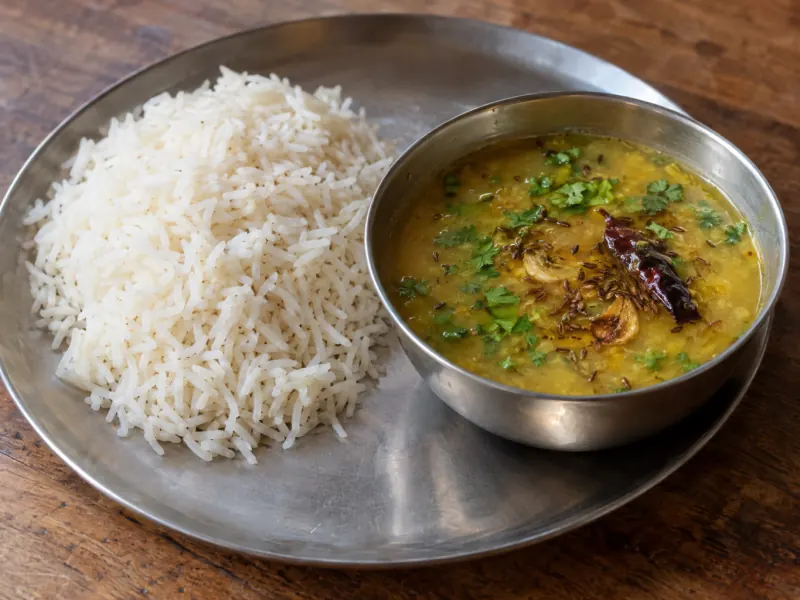
Dal bhat (DAHL baht) is Nepal's everyday meal of soupy lentils and plain steamed rice, eaten together and usually served with a vegetable tarkari and a sharp achar. This version keeps quick-cooking red lentils deliberately thin. A sizzling tempering of ghee, cumin, garlic and dried chilli is poured in right at the end.
- Total55 min
- Servings4
- DifficultyEasy
Ingredients
Dal
Tempering
To serve
Rice
Method
Rinse the lentils
Put the lentils in a bowl, cover them with cold water and swirl with your hand. Drain, then repeat three or four times until the water is only slightly cloudy.
Look for: The rinsing water runs almost clear instead of milky.
Simmer the dal
Put the lentils in a large saucepan with 3¾ cups (900 ml) of the water, the turmeric and the ginger. Bring to a boil, skim off the foam, then lower the heat and simmer, partly covered, for 20–25 minutes, stirring now and then.
Look for: The lentils have lost their shape and collapse into a yellow purée when stirred.
Rinse the rice
While the dal simmers, rinse the rice in a bowl of cold water, swirling and draining four or five times. Tip it into a sieve and let it drain well.
Look for: The water around the rice is nearly clear.
Cook the rice
Put the rice and the measured water in a heavy pan with a tight lid and bring to a boil. Cover, turn the heat to the lowest setting and cook for 12 minutes without lifting the lid.
Look for: Tilt the pan after 12 minutes: there is no water left in the bottom, and small steam holes dot the surface. If a little water remains, cover and cook for 2–3 minutes more before resting.
Rest the rice
Take the rice off the heat and leave it covered for 10 minutes. Fluff it with a fork just before serving.
Look for: The grains are tender, separate and dry on the surface.
Loosen and season the dal
Whisk the lentils briskly to break them up, then stir in the remaining water and the salt. Simmer for 5 minutes more, adding a splash of extra water if it has thickened.
Look for: The dal pours like a thin soup and only lightly coats the back of a spoon.
Make the tempering
Heat the ghee in a small frying pan over medium heat. Add the cumin seeds and the dried chillies and let them sizzle for about 30 seconds. Add the asafoetida (if using) and the garlic and fry for about 1 minute.
Look for: The cumin smells toasty and the garlic is light golden at the edges, not brown.
Finish the dal
Pour the hot tempering into the dal; it will spit, so stand back and cover the pan for a few seconds. Stir, check the salt and scatter over the coriander.
Look for: Gold flecks of ghee float on the surface of the dal.
Serve
Mound the rice on plates and serve the dal in bowls alongside or ladled over the top, with a vegetable tarkari and achar if you have them. Mix rice and dal together as you eat.
Why this works
- Cooking the lentils in most of the water and adding the rest after whisking makes it easy to beat them smooth and then set the final, soupy consistency exactly.
- Rinsing the rice removes surface starch. The 1:1.5 rice-to-water ratio by volume (300 g basmati to 560 ml water) then gives separate grains that soak up the thin dal.
- Cooking the turmeric and ginger with the lentils mellows them. The garlic, cumin and chilli go in at the end in hot ghee, so their aroma stays sharp.
Common mistakes
- Dal that is too thick: Nepali dal should be pourable. Add hot water a little at a time until it runs off the spoon, and bring it back to a simmer before serving.
- Burnt tempering: garlic goes from golden to bitter in seconds. Add it after the cumin, keep the heat at medium and pour the tempering in as soon as the edges colour.
- Gummy rice: lifting the lid lets the steam out, and stirring breaks the grains. Leave the pan covered for the full cooking and resting time.
Swaps
- split red lentils (masoor dal) → split yellow mung beans (moong dal) or split pigeon peas (toor dal). Toor dal needs about twice the simmering time and may need extra water.
- ghee → vegetable oil or mustard oil. Heat mustard oil until it just smokes, then cool it slightly before adding the cumin.
- asafoetida (hing) → a pinch of jimbu (dried Himalayan allium) or simply leave it out. Asafoetida is sold in Indian grocers and many large supermarkets. Most ground asafoetida is blended with wheat flour, so check the label if wheat is a concern, or leave it out.
- basmati or other long-grain white rice → any long-grain white rice such as jasmine. Use slightly less water for jasmine, about 520 ml for the same amount of rice.
Storage
Cool the dal and refrigerate it in a covered container for up to 4 days, or freeze it for up to 3 months. It thickens as it sits, so reheat it with a splash of water until it is simmering. Refrigerate leftover rice within 1 hour of cooking and use it within 1 day. Reheat the rice only once, until steaming hot throughout.
Scaling
To double the recipe, use a wide pot for the dal so it simmers evenly, and allow 5–10 minutes more for the lentils to break down. Cook the rice in a larger heavy pan with the same ratio; it may need 2–3 extra minutes before resting. When halving, use a small saucepan and keep the timings the same.
Make ahead
The dal can be made up to 2 days ahead without the tempering. Reheat it, loosen it with water and add a fresh tempering just before serving. Cook the rice fresh.
Nutrition per serving
- Calories
- 525 kcal
- Protein
- 18 g
- Carbohydrates
- 94 g
- Sugars
- 0 g
- Fibre
- 7 g
- Fat
- 8 g
- Saturated fat
- 4.3 g
- Sodium
- 885 mg
Estimated from the raw ingredients using USDA FoodData Central values; actual values vary with brands and portion size.
Contains
- Gluten
- Milk
Derived from the ingredient list. Always check the labels of the products you buy. Allergens and health
Questions
Why is my dal watery and separated instead of smooth?
The lentils were not cooked long enough to break down. Keep simmering until they collapse, then whisk hard before adding the rest of the water.
Can I cook the dal in a pressure cooker?
Yes. Cook the lentils with the first portion of water, the turmeric and the ginger for 2 whistles or about 5 minutes at high pressure, release the pressure, then loosen and temper the dal as in the recipe.
What do I serve with dal bhat?
A vegetable tarkari such as potato and cauliflower curry, a tangy achar and sautéed greens are the usual sides. Yogurt or papad are common additions.
Cook next


Published November 20, 2026 · Updated · Published by Recipe Worldwide · How we make recipes