Main dishesColombian
Bandeja Paisa
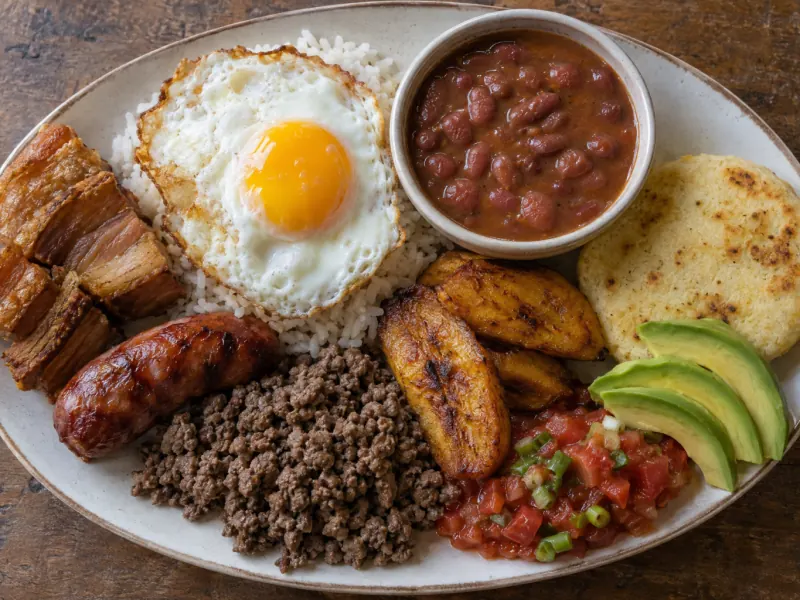
Bandeja paisa (bahn-DAY-hah PIE-sah) is the big platter of Antioquia, Colombia: beans, rice, crisp pork belly, chorizo, ground beef, a fried egg, sweet plantain, arepa and avocado. This version is built around one long bean simmer. The pork belly is boiled until tender, dried, then fried crisp in its own fat.
- Total13 h 20 min
- Servings8
- DifficultyMedium
Ingredients
Beans
Pork
Hogao
Rice
Meats
Arepas
To serve
Method
Soak the beans
Cover the beans with plenty of cold water and leave them to soak for at least 8 hours or overnight. Drain and rinse.
Look for: The beans have roughly doubled in size and the skins look smooth and plump.
Simmer the beans with pork
Cut 4 oz (120 g) pork belly into chunks and put it in a large pot holding at least 5½ qt (5 l) with the drained beans, the carrot and 5½ cups (1.3 l) water, enough to cover the beans by 1½ in (4 cm)–2 in (5 cm). Bring to a boil, skim the foam, then simmer gently, partly covered, for 1½–2 hours. Keep the rest of the water hot and add it as needed to keep the beans covered and the broth loose.
Look for: A bean squeezed between two fingers is creamy all the way through, with no chalky centre.
Make the hogao
While the beans cook, heat 2 tbsp (32 ml) oil in a frying pan over medium-low heat and add the onion, spring onions and 3 garlic. Cook for 5 minutes, then add the tomatoes and ¼ tsp salt and cook, stirring now and then, for 15 minutes.
Look for: The sauce is thick and jammy, and oil pools at the edges.
Finish the beans
Lift out the carrot, mash it and stir it back into the beans with half the hogao and 1¼ tsp salt. Simmer uncovered for another 15–20 minutes, stirring occasionally; the beans should stay brothy.
Look for: The broth has turned reddish-brown and lightly coats the back of a spoon.
Cook the rice
Heat 1 tbsp (16 ml) oil in a heavy saucepan of about 3 qt (3 l) capacity over medium heat, add the rice and stir for 1–2 minutes. Pour in the boiling water, add 1¼ tsp salt and boil uncovered over medium-high heat for about 8 minutes, until the water drops below the surface of the rice. Cover tightly, cook over the lowest heat for 15 minutes, then rest off the heat, still covered, for 5 minutes.
Look for: Before covering, small steam holes dot the surface; at the end the grains are tender and separate and the water is fully absorbed.
Boil the chicharrón
Cut the remaining pork belly into eight pieces about 2 in (5 cm) wide. Score the meat side into fingers about ¾ in (2 cm) apart, stopping short of the skin, and rub all over with ¾ tsp salt. Put the pieces in a saucepan where they fit snugly, pour in enough of the water to cover them by ⅓ in (1 cm)–¾ in (2 cm) and simmer, covered, for 30 minutes, then drain and pat very dry.
Look for: The meat is tender when pierced with a knife and the skin looks pale and swollen.
Fry the chicharrón
Put the pork belly skin side down in a wide, heavy, dry frying pan and fry over medium heat for 25–30 minutes, turning to brown every side and using a splatter guard. Check that the thickest part reads at least 145 °F (63 °C), then rest for 3 minutes on paper towels. Keep the rendered fat in the pan.
Look for: The skin has puffed and blistered and crackles when tapped, and the fingers are deep golden.
Cook the chorizo
Prick the chorizo in a few places and cook it in a second frying pan with a spoonful of the rendered pork fat over medium heat, turning often, for 12–15 minutes, until the centre reads 160 °F (71 °C).
Look for: The casings are browned all over and the juices run clear.
Cook the ground beef
Heat 1 tbsp (16 ml) oil in a frying pan over medium-high heat and add the beef, 1 garlic, the cumin and ½ tsp salt. Break the meat into very fine crumbles and cook for 10–12 minutes, until it reads 160 °F (71 °C), then stir in a few spoonfuls of the hogao.
Look for: No pink remains, the liquid has cooked off and the crumbs are dry and browned.
Make the arepas
Stir 1 tsp salt into the masarepa, then gradually pour in 2 cups (495 ml) warm water, mixing with your hand. Knead for 2–3 minutes until the dough is soft and smooth like play dough; if a pressed ball cracks at the edges, work in more of the warm water a spoonful at a time. Rest for 5 minutes, shape into eight discs about 4 in (10 cm) across and ⅓ in (1 cm) thick, and cook in batches on a griddle greased with the butter over medium heat for 5–6 minutes per side.
Look for: The dough feels smooth and doesn't crack at the edges when pressed, and the cooked arepas have pale golden spots and sound hollow when tapped.
Fry the plantains and eggs
Slice the plantains on the diagonal about ⅓ in (1 cm) thick. Fry them in batches in the remaining oil over medium heat for 3–4 minutes per side, then drain. Fry the eggs in batches in the same pan until the whites are set and the edges are lacy.
Look for: The plantains are deep caramel-brown and soft right through, and the egg whites are opaque with crisp edges.
Assemble the plates
Halve, stone and slice the avocado. On each large plate, arrange rice topped with a fried egg, a bowl or mound of beans, ground beef, chicharrón, chorizo, plantains, an arepa, the avocado and a spoonful of the remaining hogao.
Why this works
- The 120 g of pork belly simmered with the beans gives the broth body and pork flavour, and the mashed carrot thickens it without flour.
- The hogao goes into the beans only once they are tender, because the acid in the tomatoes slows how fast the skins soften.
- Boiling the pork belly for 30 minutes before frying tenderises the meat and loosens the fat, so it renders and crisps in a dry pan without burning on the outside first.
- Masarepa needs a little over twice its weight in warm water to hydrate fully; with less, the dough crumbles and the arepas crack as they cook.
Common mistakes
- Chicharrón that spits and stays chewy: the boiled pork was not dried well or the heat was too high, which browns the meat before the skin can puff. Pat it completely dry and fry steadily over medium heat.
- Grey, wet ground beef: a crowded pan or low heat makes it steam. Use a wide pan over medium-high heat and keep cooking until all the liquid is gone and the crumbs are fine and dry.
- Beans that catch on the bottom of the pot: the water dropped below the beans during the long simmer. Check every 20 minutes and top up with hot water so they stay covered and brothy.
Swaps
- dried cranberry (cargamanto) beans → Borlotti beans or red kidney beans. Borlotti are the closest match to cargamanto and are easy to find in the UK and Australia. Kidney beans hold their shape more and may need the full 2 hours.
- small fresh Colombian-style pork chorizos → Fresh garlicky pork sausages with a pinch of sweet paprika. Cured Spanish chorizo is drier and smokier, but it works too. Slice it and brown it for 3–4 minutes instead of cooking it through.
- masarepa (precooked white cornmeal) for arepas → Shopping tip: look for precooked white maize flour such as P.A.N.. It is sold as masarepa, harina precocida or arepa flour in Latin American shops, some large supermarkets and online. Masa harina, polenta and regular cornmeal won't form the same smooth dough, so don't use them.
- beef mince (ground beef), about 15% fat → Flank or skirt steak for carne en polvo. Simmer or griddle the steak until cooked through, then pulse it in a food processor until fine and fry briefly with the hogao.
Storage
Refrigerate the components separately within 2 hours. Beans keep 4 days and freeze for up to 3 months. Beef and chorizo keep 3 days. Cool rice quickly, spread out, and refrigerate within an hour; eat it within 24 hours and reheat until piping hot, only once. Reheat the beans and beef until steaming. Re-crisp the chicharrón in a dry pan over medium heat for 5 minutes. Arepas keep 3 days and reheat in a dry pan. Fry the eggs and plantains fresh.
Scaling
To double, cook the beans in a 10–12 litre pot, still covered by 4–5 cm of water; the simmering time stays about the same, though the water may need topping up more often. Cook the rice in a wide 5-litre pan. Boil and fry the pork belly in two pans so the pieces are not crowded. Fry the plantains, eggs and arepas in batches. To halve, use a 3-litre pot for the beans and a 1.5–2 litre saucepan for the rice.
Make ahead
Cook the beans and hogao up to 2 days ahead and refrigerate. The beans thicken as they sit, so loosen them with a splash of water when reheating. The pork belly can be boiled a day ahead, dried and chilled, then fried just before serving. The arepa dough can be shaped a few hours ahead, covered and chilled.
Nutrition per serving
- Calories
- 1565 kcal
- Protein
- 49 g
- Carbohydrates
- 125 g
- Sugars
- 16 g
- Fibre
- 18 g
- Fat
- 97 g
- Saturated fat
- 30.3 g
- Sodium
- 2155 mg
Estimated from the raw ingredients using USDA FoodData Central values; actual values vary with brands and portion size. Salt in drained cooking water is not included.
Contains
- Gluten
- Milk
- Egg
- Soy
Derived from the ingredient list. Always check the labels of the products you buy. Allergens and health
Questions
Can I cook the beans in a pressure cooker?
Yes. Cook the soaked beans with the pork, carrot and enough water to cover by about 4 cm at high pressure for 12–15 minutes, then release naturally. If they are not yet creamy, cook a few minutes more, then finish with the hogao on the stovetop as in step 4.
Is it safe to serve the egg with a runny yolk?
A runny yolk is common here. Pregnant people, young children, older adults and anyone whose body has difficulty fighting infection should cook eggs until firm or use pasteurised eggs.
Can I use green plantains?
Green plantains won't sweeten or soften when fried. Some versions serve them as patacones instead: fry the slices, smash them flat, then fry them again until crisp.
Cook next
Published November 20, 2026 · Updated · Published by Recipe Worldwide · How we make recipes