Main dishesPakistani
Haleem (Pakistani Beef, Wheat and Lentil Stew)
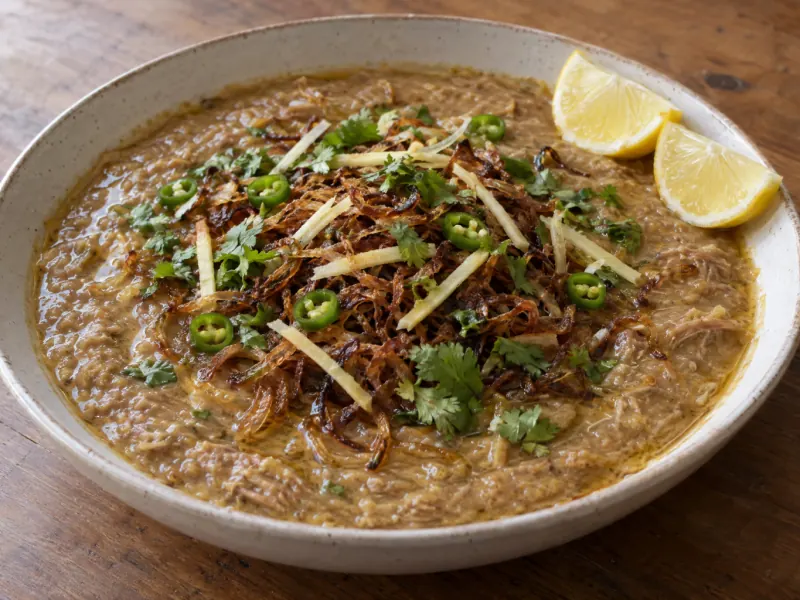
Haleem (ha-LEEM) is a thick, savoury stew of beef, wheat, barley and three kinds of dal, slow-cooked and beaten until smooth and stretchy. This version cooks the beef and the grains in separate pots so each softens fully, then joins them for a final hour of low, steady stirring.
- Total12 h 50 min
- Servings8
- DifficultyMedium
Ingredients
Haleem
To serve
Method
Soak the grains and dals
Put the cracked wheat, barley, chana dal, urad dal and moong dal in a large bowl and rinse in several changes of cold water until the water runs almost clear. Cover with plenty of fresh cold water and leave to soak overnight, at least 8 hours.
Look for: The grains have swollen and a piece of chana dal splits easily under a fingernail.
Fry the onions
Heat the oil in a large heavy-based pot over medium heat. Add the onions and fry, stirring often, for 15–20 minutes until deep golden brown, then lift them out with a slotted spoon onto paper towels, leaving the oil in the pot.
Look for: The onions are an even deep brown and crisp at the edges; take them out before any turn black.
Fry the beef with spices
Add the garlic and ginger to the hot oil and stir for 1 minute. Add the beef, turmeric, chilli powder, ground coriander, cumin and 1¼ tsp of the salt and fry for 5 minutes, turning the pieces.
Look for: The garlic and ginger smell cooked rather than raw, and the spices coat the beef.
Simmer the beef
Pour in 6½ cups (1.5 l) of the water, add about a third of the fried onions, bring to the boil, then cover and simmer gently for 2–2½ hours. Stewed beef is safe long before it is tender (well past 145 °F (63 °C)), so judge it by texture: keep simmering until a piece falls apart when pressed with a spoon.
Look for: A piece of beef falls apart when pressed with the back of a spoon.
Cook the grains
Meanwhile, drain the soaked cracked wheat, barley and dals and put them in a second pot with 6½ cups (1.5 l) of the water. Bring to the boil, skim off the foam, then simmer partly covered for 60–75 minutes, stirring now and then, until everything is completely soft. Mash with a potato masher or pulse briefly with an immersion (stick) blender until mostly smooth.
Look for: A piece of chana dal crushes to a paste between two fingers with no hard centre.
Shred the beef
Lift the beef out of its cooking liquid with a slotted spoon, remove any gristle, and shred it finely with two forks or pound it lightly in a large mortar.
Look for: The beef separates into fine threads with no firm pieces left.
Combine and cook slowly
Return the shredded beef to its cooking liquid, stir in the mashed mixture of cracked wheat, barley, chana dal, urad dal and moong dal with the remaining salt, and cook over low heat for about 1 hour, stirring and scraping the bottom of the pot every 5 minutes. If it becomes too stiff to stir, loosen it with up to 1 cup (250 ml) of the hot water.
Look for: The mixture is thick enough that a spoon dragged across the base leaves a clear trail for a second.
Beat until stretchy
Take the pot off the heat and beat the haleem hard with a sturdy wooden spoon for 5–10 minutes, or pulse an immersion blender through it in short bursts, until the beef threads blend into a smooth, thick paste.
Look for: The haleem pulls into stretchy strands when the spoon is lifted.
Finish with ghee and spice
Return the pot to low heat and stir in the garam masala, ghee and another third of the fried onions. Cook for 5 minutes, stirring, until the ghee is fully absorbed, then taste and add a pinch more salt if the wheat and dal have dulled it.
Look for: The surface turns glossy and no pools of ghee remain.
Serve
Ladle the haleem into warm bowls and top with the remaining fried onions, the ginger strips, coriander leaves and green chillies. Serve hot with lemon wedges for squeezing over, and naan or roti on the side.
Why this works
- Cooking the beef and the grains in separate pots lets each soften fully: chana dal and barley need about an hour of free simmering, and in one crowded pot they catch on the bottom before they turn soft.
- Soaking the 380 g of grains and dals overnight shortens their cooking time and helps the chana dal, the hardest of them, break down completely instead of staying chalky.
- Chuck or shank works better than lean steak because its connective tissue melts during the long simmer, so the beef shreds into fine threads that disappear into the paste.
- Frying the onions first flavours the oil the beef and spices then cook in, and the same onions go into the pot, into the finish and on top.
Common mistakes
- Scorched bottom: once the beef and grains are combined the mixture sticks easily. Keep the heat low, use a heavy pot and scrape the base every few minutes.
- Grainy texture: undercooked chana dal stays chalky in the finished haleem. Make sure it crushes to a paste before you combine the two pots.
- Bitter onions: fried onions keep darkening after they leave the oil, so lift them out when they are deep brown, not almost black.
Swaps
- Cracked wheat (dalia) → Pearled wheat berries (sold as haleem wheat in South Asian shops). Crush them lightly in a mortar before soaking; they may need 15–30 minutes longer to soften.
- Boneless beef chuck or shank → Boneless lamb or mutton shoulder. Closer to the Hyderabadi style; lamb usually shreds after about 1½–2 hours of simmering.
- Split white urad dal → Split red lentils (masoor dal). Use the same weight; red lentils are easy to find in supermarkets and soften quickly.
- Ghee → Unsalted butter. Use the same amount; the finish will be a little less nutty.
Storage
Divide the haleem into shallow containers so it cools quickly, and refrigerate within 2 hours, covered, for up to 3 days, or freeze for up to 3 months. It sets firm as it cools: reheat it gently in a pan with a splash of water, stirring, until steaming hot all the way through. Keep the fried onions and fresh toppings separate and add them after reheating.
Scaling
For a double batch, use a pot of at least 8 litres for the combined haleem and expect the grains to need about 15 minutes longer; the final stirring stage also takes longer because there is more liquid to cook off. A half batch follows the same timings, but scrape the base more often, as a smaller amount catches faster.
Make ahead
Fry the onions up to 2 days ahead; keep them airtight at room temperature and save the frying oil in a jar to start the beef. The whole haleem can be cooked a day ahead and reheated; it thickens overnight, so add a little water as it warms.
Nutrition per serving
Nutrition is not shown because it could not be calculated reliably from the ingredients.
Contains
- Gluten
- Milk
- Soy
Derived from the ingredient list. Always check the labels of the products you buy. Allergens and health
Questions
What is the difference between haleem and khichra?
Both use the same meat, grains and dals. In khichra the meat stays in cubes, while in haleem it is shredded and beaten into the porridge until smooth.
Why is my haleem not stretchy?
The stretch comes from fully softened wheat and barley being beaten together with the shredded meat. Cook the grains until they crush easily, beat for the full time, and avoid adding too much water at the end.
Can I use lamb instead of beef?
Yes. Lamb or mutton is the usual choice in Hyderabadi haleem; it often becomes tender sooner than beef, so start checking after about 1½ hours.
Cook next


Published November 26, 2026 · Updated · Published by Recipe Worldwide · How we make recipes