Homemade Doner Kebab
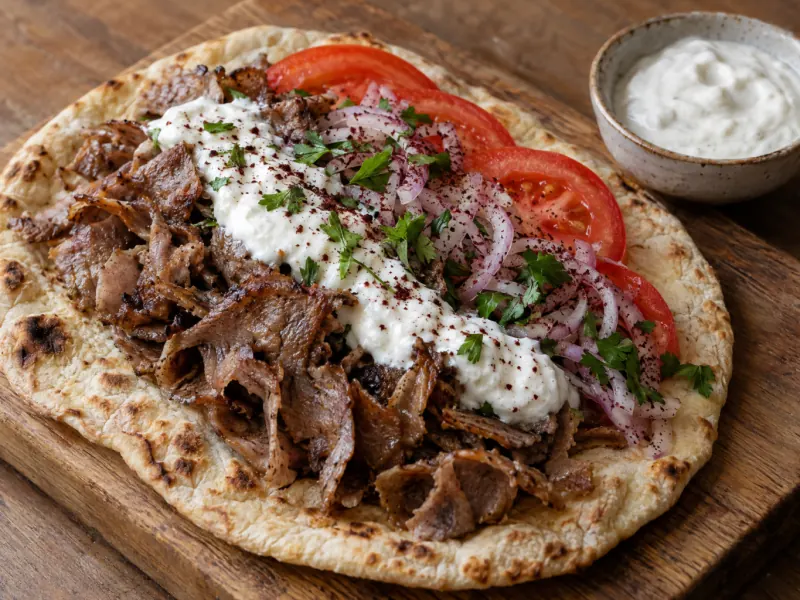
Doner kebab (DUH-ner keh-BAHP) is seasoned meat roasted on a vertical spit and shaved into flatbread. Without a rotisserie, this version blends spiced minced lamb into a dense paste, roasts it as a loaf, then slices it thin and sears the slices so the edges crisp, much as meat cut from the spit does.
- Total1 h 55 min
- Servings4
- DifficultyMedium
Ingredients
Meat
To cook
Garlic yogurt
To serve
Method
Heat the oven and prepare the onion
Heat the oven to 350 °F (180 °C) (this is a conventional setting, not fan). Grate the onion on the fine side of a box grater, then wrap it in a clean tea towel (kitchen towel) and squeeze out as much liquid as you can.
Look for: The squeezed onion should be a damp, compact pulp with no liquid dripping.
Blend the meat to a paste
Use the lamb straight from the fridge (or chill it for 15 minutes in the freezer) so the fat stays firm while processing. Put the lamb, squeezed onion, crushed garlic, salt, black pepper, cumin, paprika, oregano and pul biber in a food processor and process for about 2 minutes, scraping down the sides twice.
Look for: The mixture turns paler, smooth and sticky, and clings to the spatula instead of crumbling.
Shape a tight log
Tip the lamb paste onto a sheet of baking paper (parchment) and shape it into a firm log about 8 in (20 cm) long and 3 in (7 cm) in diameter, pressing hard to squeeze out air pockets. Trim the paper to a strip just wider than the log, then set the log, still on its paper strip, on a wire rack over a roasting tray (roasting pan) so the fat can drip away without the soft paste sagging through the bars.
Look for: The surface should look smooth with no cracks or gaps.
Roast
Roast the lamb log at 350 °F (180 °C) for 60–70 minutes, until the centre reaches 160 °F (71 °C) on an instant-read thermometer.
Look for: The outside is deep brown and the log feels firm when pressed; rely on the thermometer reading of 160 °F (71 °C).
Rest and make the garlic yogurt
Let the meat rest on the rack for 10 minutes. Meanwhile stir the yogurt with the grated garlic and the pinch of salt.
Prepare the toppings
Toss the red onion with the sumac and parsley, rubbing the onion lightly with your fingers. Slice the tomatoes.
Look for: The onion slices soften slightly and turn a deeper pink from the sumac.
Slice thin
Cut the rested log lengthways in half, then shave each half into slices as thin as you can manage with a long, sharp knife.
Look for: The slices should hold together and be thin enough to bend without breaking.
Sear the slices
Heat the olive oil in a large frying pan (skillet) over medium-high heat. Sear the lamb slices in a single layer, in batches, for about 1 minute per side; allow 8–10 minutes in total.
Look for: The slices sizzle steadily and the edges turn brown and crisp.
Warm the bread and assemble
Warm the flatbreads in a dry pan for 20–30 seconds per side. Fill each one with the seared lamb, tomatoes, sumac onions and a spoonful of garlic yogurt, then fold or roll.
Look for: The bread should be soft and pliable, with a few light brown spots.
Why this works
- Processing the lamb for a full 2 minutes binds the meat proteins into a dense, springy mass, so it slices into thin sheets resembling spit-roasted doner instead of crumbling into meatloaf texture.
- Squeezing the grated onion dry keeps its flavour but removes the water that would make the log soft and steam rather than brown.
- Lamb mince with about 20% fat keeps the slices juicy. Keeping it cold while processing stops that fat smearing, and the rack lets excess fat drip away so the outside browns.
- Searing the thin slices after roasting creates the crisp edges you get on meat shaved from the outer layer of a spit.
Common mistakes
- Stopping the food processor after 30–60 seconds, when the lamb still looks minced: the log then cracks and crumbles under the knife. Run it the full 2 minutes; a pinch of paste pressed between two fingers should stretch slightly and stick, not break into strands.
- Slicing the log hot or too thick: let it rest for the full 10 minutes and use your sharpest knife. For the thinnest slices, chill it first (see make-ahead).
- Crowding the pan when searing: the slices steam and stay grey. Work in batches and keep the heat high.
Swaps
- lamb mince (ground lamb), about 20% fat → beef mince (ground beef), about 20% fat, or half lamb, half beef. Same method and timing. Very lean mince gives drier, crumblier slices.
- Aleppo pepper (pul biber) → half the amount of red pepper flakes. Pul biber is milder and fruitier than most chilli flakes, so use less of the substitute.
- ground sumac → a squeeze of lemon juice. Toss it with the onion just before serving to give the same sharpness.
- pide, pita or lavash flatbreads → yufka or large soft wraps. Thin breads roll more tightly. Pide or thick pita can be split and filled as a pocket.
Storage
Cool and refrigerate within 2 hours of roasting. Keep the unsliced roasted log or the slices in an airtight container in the fridge for up to 3 days, or freeze for up to 3 months and thaw overnight in the fridge. Reheat the slices in a hot frying pan with a little oil until sizzling and hot through. The garlic yogurt keeps for 3 days in the fridge.
Scaling
To double, shape two logs of the same size instead of one thicker log, so the roasting time stays about the same. Use two racks or one large tray with space between the logs. To halve, make a shorter log of the same diameter and start checking the internal temperature after 40 minutes.
Make ahead
Roast the log up to 2 days ahead, cool it and refrigerate it whole. A cold log slices much thinner. Sear the slices just before serving. The paste can also be mixed and shaped a day ahead and kept covered in the fridge before roasting.
Nutrition per serving
- Calories
- 785 kcal
- Protein
- 39 g
- Carbohydrates
- 50 g
- Sugars
- 7 g
- Fibre
- 4 g
- Fat
- 47 g
- Saturated fat
- 19.5 g
- Sodium
- 1420 mg
Estimated from the raw ingredients using USDA FoodData Central values; actual values vary with brands and portion size. A small amount of a flavouring without reliable nutrition data is not included.
Contains
- Gluten
- Milk
Derived from the ingredient list. Always check the labels of the products you buy. Allergens and health
Questions
Does it work without a food processor?
Yes. Knead the cold mixture vigorously in a bowl for 5–8 minutes, slapping it against the sides, until it turns sticky and holds together. The texture will be slightly coarser.
Why did my doner turn out crumbly?
The meat was not worked long enough, it warmed up in the processor, or the onion was too wet. Start with cold lamb, process until the paste is smooth and tacky, and squeeze the onion thoroughly.
Can chicken be used instead?
Use minced chicken thigh rather than breast so it stays moist, and roast until the centre reaches 74°C (165°F).
Cook next

Published November 20, 2026 · Updated · Published by Recipe Worldwide · How we make recipes