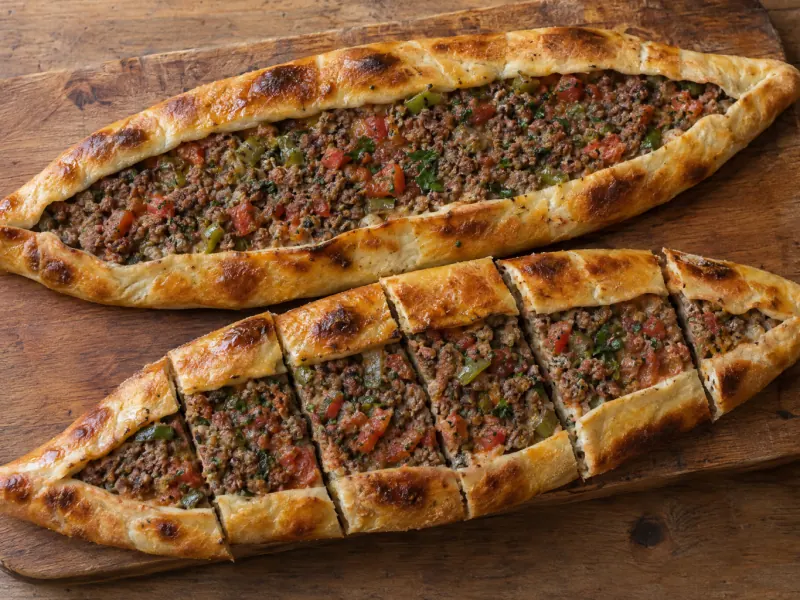
Turkish Pide (Kıymalı Pide with Minced Beef)
Pide (pee-DEH) is Turkey's boat-shaped filled flatbread, and this is kıymalı (KUH-mah-luh) pide, made with minced beef and onion. The filling goes on raw and cooks with the dough, while a preheated heavy tray stands in for a stone oven floor so the base crisps before the meat dries out.
- Total2 h 27 min
- Servings4
- DifficultyMedium
Ingredients
dough
filling
to finish
Method
Make the dough
Mix the flour, yeast and dough salt in a large bowl, then add the lukewarm water and the melted butter for the dough. Knead by hand for 8–10 minutes, or 6 minutes in a stand mixer with a dough hook.
Look for: The dough is smooth, soft and slightly tacky, and springs back slowly when pressed.
First rise
Cover the bowl and leave the dough in a warm spot until doubled.
Look for: A floured finger pressed into the dough leaves a dent that fills back only slowly.
Mix the filling
Squeeze the chopped onion and tomato in your hands over the sink to remove excess juice. Combine them with the beef, green pepper, parsley, filling salt, black pepper and pepper flakes, and knead with your hand for 1–2 minutes, then chill until needed.
Look for: The mixture looks evenly flecked and holds together like a soft paste.
Preheat the oven and tray
About 30 minutes before baking, put a heavy upturned baking tray (sheet), baking steel or pizza stone on the lowest shelf and heat the oven to 480 °F (250 °C).
Divide and rest
Tip the dough onto a surface dusted with some of the dusting flour, divide it into four equal pieces and shape each into a ball. Cover and rest for 15 minutes so the gluten relaxes.
Look for: The balls look puffy and stretch without springing back.
Roll the ovals
Roll each ball on lightly floured baking paper (parchment) into a long oval about 12 in (30 cm) by 6 in (15 cm), using the rest of the dusting flour as needed. Work on two sheets of paper so you can bake two pides at a time.
Look for: The oval is about 30 × 15 cm and roughly 4 mm thick, thin but not translucent.
Fill and shape
Spread a quarter of the beef filling thinly down the middle of each oval, leaving a ¾ in (2 cm) border. Fold the long edges inwards over the rim of the filling, then pinch and twist each end into a point to form a boat.
Look for: The filling is an even, thin layer and the ends are pinched firmly so they do not open in the oven.
Glaze the rims
Brush the folded dough edges with the beaten egg, keeping it off the paper where it would burn.
Bake
Use a pizza peel or a rimless baking sheet to slide two pides on their paper onto the hot tray; if your stone is small, bake one at a time. Bake at 480 °F (250 °C) for 9–12 minutes; the paper may brown at this temperature, which is normal. Insert an instant-read thermometer almost horizontally into the thickest part of the filling: it should read 160 °F (71 °C), with the filling browned and the juices bubbling and clear.
Look for: The rims are deep golden with darker spots, the base is crisp and the filling is browned and sizzling at the edges.
Butter and slice
Brush the hot crusts with the melted butter for finishing straight from the oven, rest for 2 minutes, then cut across into strips. Let the tray reheat for 5 minutes before baking the second pair the same way, and serve hot.
Look for: The butter soaks in and leaves the crust glossy.
Why this works
- Squeezing the juice out of the onion and tomato keeps the raw filling from releasing liquid onto the dough, which is what turns the base soggy.
- 325 ml water to 500 g flour (65% hydration) gives a dough soft enough to stretch thin but firm enough to hold its boat shape in a home oven.
- A preheated heavy tray at 250°C delivers fast bottom heat, standing in for a stone oven floor so the base crisps in the 10 minutes the thin meat layer needs to cook.
- Beef with 15–20% fat stays moist in the very hot oven; very lean mince turns dry and crumbly.
Common mistakes
- Spreading the filling too thickly: the dough browns before the meat reaches 71°C. Keep it to a thin layer and check it by inserting the thermometer almost horizontally into the thickest part of the filling, so the probe does not touch the tray.
- Baking on a cold tray: the base stays pale and soft. Give the tray or stone the full 30 minutes of preheating, and let it reheat for 5 minutes between rounds.
- Leaving the ends loosely pinched: they unfold and the juices run onto the paper. Pinch firmly and twist the points.
Swaps
- minced (ground) beef, 15–20% fat → minced lamb, or half lamb and half beef. Lamb is also used for kıymalı pide; choose mince with a similar fat level.
- long mild green pepper → half a green bell pepper. Turkish sivri biber is hard to find outside specialist shops; bell pepper is milder but works.
- Turkish red pepper flakes (pul biber) → ½ tsp sweet paprika plus a pinch of chilli flakes. Pul biber is sold in Middle Eastern grocers; this mix gives similar colour and mild heat.
- plain (all-purpose) flour → bread flour (strong white flour). Add about 15 ml more water; the crust will be slightly chewier.
Storage
Refrigerate within 2 hours of baking, wrapped, for up to 3 days. Reheat in a 200°C (400°F) oven on a tray for 6–8 minutes until hot through; a microwave makes the crust soft. Baked pide freezes for up to 2 months; reheat from frozen at the same temperature for 12–15 minutes.
Scaling
Halving: use 250 g flour and about 4 g yeast; the rise time stays the same. Doubling: mix the dough in two batches if your mixer is small and bake in four rounds of two, giving the tray 5 minutes to reheat between rounds. Baking time per pide does not change.
Make ahead
For a slow fridge rise of up to 24 hours, use about 4 g yeast instead of 7 g so the dough does not overproof, and knock it back once after 3–4 hours. Let it sit at room temperature for 30 minutes before dividing. The filling can be mixed up to 12 hours ahead and kept covered in the fridge.
Nutrition per serving
- Calories
- 865 kcal
- Protein
- 34 g
- Carbohydrates
- 106 g
- Sugars
- 3 g
- Fibre
- 5 g
- Fat
- 33 g
- Saturated fat
- 14.5 g
- Sodium
- 1550 mg
Estimated from the raw ingredients using USDA FoodData Central values; actual values vary with brands and portion size.
Contains
- Gluten
- Milk
- Egg
Derived from the ingredient list. Always check the labels of the products you buy. Allergens and health
Questions
Should the meat be cooked before it goes on the pide?
Styles differ: Bafra pide uses meat cooked before filling, while Çarşamba pide bakes raw meat and onion with the dough. This recipe uses the raw method, which works if the layer is thin and the thickest part of the filling reaches 71°C.
Why is my pide base soggy?
Usually the filling was too wet or the tray was not hot enough. Squeeze the onion and tomato well and preheat the tray for the full 30 minutes.
Can pide be baked without a pizza stone?
Yes. A heavy baking tray turned upside down and preheated on the lowest shelf does the same job.
Cook next
Published November 20, 2026 · Updated · Published by Recipe Worldwide · How we make recipes