Main dishesMoroccan
Pastilla (Moroccan Chicken and Almond Pie)
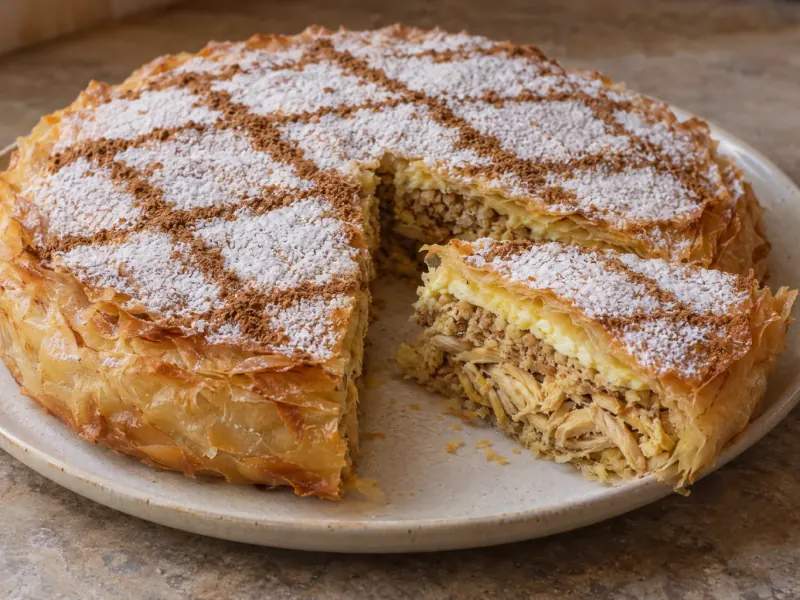
Pastilla (pas-TEE-ya), also spelled bastilla, is a Moroccan pie of thin pastry wrapped around saffron and ginger chicken, soft-set eggs and a sweet layer of toasted almonds, dusted with powdered sugar and cinnamon. This version sets the eggs in the reduced onion sauce and drains them well, so the base bakes crisp instead of soggy.
- Total3 h 30 min
- Servings8
- DifficultyMedium
Ingredients
Chicken filling
Almond layer
Pastry and finish
Method
Soften the onions
Melt the butter in a wide, heavy pot over medium heat. Add the onions and salt and cook, stirring often, for about 10 minutes until soft and translucent but not browned. Add the saffron, ginger, turmeric, cinnamon and pepper and cook, stirring, for 1 minute.
Look for: The onions are soft and pale and the spices smell fragrant.
Simmer the chicken
Add the chicken, parsley and water, turning the chicken to coat it in the onions. Cover and simmer gently for 35–40 minutes, turning once, until the chicken pulls apart easily and the thickest piece reads 165 °F (74 °C) on a thermometer.
Look for: The meat shreds easily with a fork.
Shred the chicken and reduce the sauce
Lift the chicken onto a plate. Boil the onion sauce uncovered over medium-high heat for 10–15 minutes, stirring now and then, until it has reduced by about half. Meanwhile shred the chicken into fine strands with two forks, then toss it with 3 tbsp (45 ml) of the reduced sauce so it stays moist.
Look for: The sauce coats a spoon and the onions have almost melted into it.
Set the eggs in the sauce
Lower the heat to medium-low and pour the eggs into the sauce. Stir slowly and continuously for 4–6 minutes until they form soft, moist curds, then tip into a sieve set over a bowl and leave to drain.
Look for: Soft, creamy curds with no loose liquid pooling around them.
Make the almond layer
Toast the almonds in a dry skillet over medium heat for 6–8 minutes, shaking the pan, until golden. Cool them, then pulse in a food processor with the powdered sugar, cinnamon and orange blossom water until they look like coarse sand with a few small pieces.
Look for: A snapped almond is light golden right through.
Cool the fillings
Spread the chicken and the drained eggs on separate plates and leave them to cool for about 30 minutes. Warm fillings steam the pastry from the inside.
Look for: Both fillings feel cool to the touch.
Line the pan
Heat the oven to 375 °F (190 °C). Brush a 10 in (26 cm) springform or loose-bottomed tin at least 2 in (5 cm) deep with melted butter, and keep the warqa covered with a damp towel while you work. Brush a sheet of warqa with butter and lay it so half covers the base and half hangs over the rim; repeat with seven more sheets, overlapping them all the way round, then lay one more buttered sheet flat in the centre of the base.
Fill the pie
Spread the eggs over the base. Cover with another sheet of warqa brushed with melted butter, add the chicken in an even layer, then scatter the almonds over it and press down lightly.
Close the top
Fold the overhanging warqa over the filling, brushing each flap with melted butter. Brush the last two sheets with butter, lay them on top and tuck their edges down the sides of the pan, then brush the top with the egg yolk.
Bake and rest
Set the tin on a baking sheet and bake on the lower-middle shelf at 375 °F (190 °C) for 30–35 minutes until the top is deep golden and crisp. Rest for 10–15 minutes until the top looks dry, then release the springform ring or push up the loose base and slide the pie onto a platter.
Look for: Deep golden brown, and the top sounds hollow when tapped.
Dust and serve
Sift the powdered sugar evenly over the top, then sprinkle the cinnamon in thin crossing lines. Cut into wedges and serve warm.
Why this works
- Reducing the onion sauce by about half before adding the 6 eggs gives soft curds that hold together; with too much liquid the eggs stay wet and the base of the pie turns soggy.
- Boneless thighs stay moist through 35–40 minutes of simmering and shred finely, which gives an even chicken layer; breast meat dries out and turns stringy.
- Toasting the almonds before grinding them with the sugar deepens their flavour and keeps the sweet layer crunchy against the soft fillings.
- Cooling both fillings before assembly stops them steaming the buttered pastry from the inside, so the layers bake crisp.
Common mistakes
- Wet egg layer: if liquid still pools around the curds, stir a little longer over low heat or drain them longer in the sieve; this is the most common cause of a soggy base.
- Dry, cracking pastry: warqa and filo dry out within minutes in open air, so keep the stack covered with a damp towel and brush each sheet with butter as you lay it.
- Dusting the sugar onto a pie straight from the oven: it melts into the damp top and disappears, so wait 10–15 minutes until the top looks dry before sifting it on.
Swaps
- warqa (brick pastry) sheets → filo (phyllo) pastry. Warqa and brick pastry are sold in some North African and Middle Eastern shops; elsewhere use filo, two sheets for every warqa sheet (about 24 in all), each brushed with butter. Filo browns faster, so start checking after 25 minutes.
- boneless skinless chicken thighs → bone-in pigeon (squab) or chicken pieces. Pigeon is the older choice. Use about a third more weight to allow for the bones, simmer until tender, then remove the skin and bones before shredding.
- unsalted butter → olive oil or a neutral oil. Moroccan Jewish cooks use oil instead of butter so that meat and dairy are not mixed; to follow that practice, use oil for the onion base as well. The pastry still crisps but tastes less rich.
- orange blossom water → finely grated orange zest. The zest of half an orange gives a similar floral citrus note if orange blossom water is hard to find.
Storage
Cool leftovers, cover and refrigerate within 2 hours for up to 3 days. Reheat uncovered in a moderate oven for 15–20 minutes until hot through; the microwave makes the pastry soft. Wrapped tightly, the baked pie can be frozen for up to 2 months; thaw overnight in the fridge, reheat the same way and dust with fresh sugar and cinnamon.
Scaling
To double, bake two pies in two pans of the same size rather than one deeper pie, so the centre heats through in the same 30–35 minutes. To halve, use a pan about two-thirds as wide with half the sheets and start checking after 20 minutes.
Make ahead
Cook the chicken and the egg layer up to 1 day ahead and keep them covered in the fridge; the almond mixture keeps for 3 days in a jar. Assemble and bake on the day so the pastry stays crisp.
Nutrition per serving
Nutrition is not shown because it could not be calculated reliably from the ingredients.
Contains
- Gluten
- Milk
- Egg
- Tree nuts
Derived from the ingredient list. Always check the labels of the products you buy. Allergens and health
Questions
Is pastilla sweet or savoury?
Both. The chicken and egg layers are savoury and spiced, while the almond layer and the powdered sugar and cinnamon on top add sweetness. The seafood version, made with fish and vermicelli, is a different savoury dish without sugar or cinnamon.
Can pastilla be made with filo instead of warqa?
Yes. Use two sheets of filo for every sheet of warqa, butter each one well and expect it to brown a little faster; the crust turns out flakier and more delicate.
Why is my pastilla soggy on the bottom?
Usually the egg layer was too wet or the fillings were still warm when the pie was assembled. Drain the eggs well, cool both fillings and bake until the top is deep golden.
Cook next
Published November 27, 2026 · Updated · Published by Recipe Worldwide · How we make recipes