Main dishesLevantine
Lebanese Kafta (Grilled Beef and Lamb Skewers)
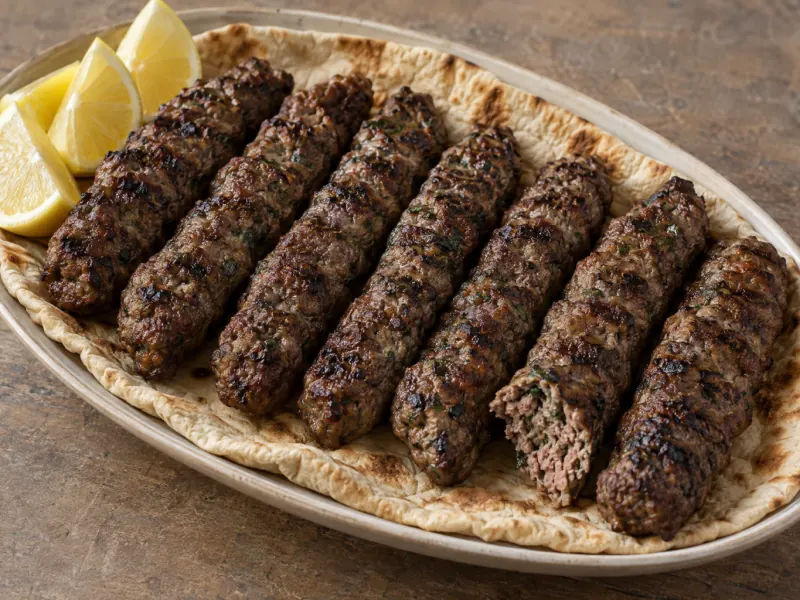
Kafta (KAHF-tuh) is Lebanese seasoned minced meat. This version kneads beef and lamb with onion, flat-leaf parsley and seven-spice; squeezing the grated onion helps the mixture grip the skewer, and a short chill makes it easier to shape. Skewers are the classic form, but kafta is also made as patties or baked in a tray.
- Total1 h 8 min
- Servings4
- DifficultyEasy
Ingredients
Method
Prepare the onion and parsley
Grate the onion or pulse it in a food processor until very fine, then squeeze it hard in a clean tea towel to remove the juice. Chop the parsley as finely as you can by hand or in short pulses.
Look for: The squeezed onion is a damp, crumbly pulp and the parsley looks almost like fine green confetti.
Mix and knead
Put the beef, lamb, squeezed onion, parsley, salt, black pepper and seven-spice in a large bowl. Knead with your hands for 2–3 minutes until the mixture turns paste-like and sticky.
Look for: A pinch of the mixture sticks to your palm when you turn your hand over.
Chill and ready the skewers
Cover the bowl and refrigerate for 30 minutes. Flat metal skewers grip best; if using wooden ones, choose eight sturdy skewers about 12 in (30 cm) long and soak them in water now, or soak sixteen and thread two side by side so the kafta doesn't spin.
Look for: The mixture feels cold and firm rather than soft.
Heat the grill
Heat a charcoal or gas grill, or a ridged grill pan (griddle pan), to medium-high. Using tongs, wipe the hot grates with a folded paper towel (kitchen paper) dipped in the oil.
Look for: On a grill, you can hold your hand above the grates for only 3–4 seconds; for a grill pan, heat for 4–5 minutes until a drop of water sizzles and evaporates immediately.
Shape on skewers
Divide the mixture into eight equal portions. With wet hands, mould each portion around a skewer (or a pair of wooden skewers) into a long, even cylinder about 6 in (15 cm) long, then press gentle finger grooves along it.
Look for: Each cylinder is the same thickness from end to end, with no cracks.
Grill
Lay the skewers on the grill and leave them alone for 2 minutes before the first turn. Then cook for another 6–8 minutes, turning every 2 minutes.
Look for: The surface is deep brown with charred grill marks and releases easily from the grates.
Check doneness
Insert a thermometer into the thickest kafta; it should read 160 °F (71 °C) in the centre. The lamb can leave a faint pink tinge even when the meat is safely cooked, so go by the thermometer rather than the colour.
Look for: The thermometer reads the target temperature in the centre and the outside is deep brown all over.
Rest and serve
Rest the skewers for 3 minutes on a platter. Warm the flatbread briefly on the grill and serve the kafta with it and the lemon wedges.
Look for: The flatbread is warm and pliable with a few toasted spots.
Why this works
- Squeezing the juice from the onion keeps the mixture firm enough to cling to the skewer; wet onion is the main reason kafta slides off.
- Kneading for 2–3 minutes works the salt into the meat proteins and makes them sticky, which binds the mixture without egg or breadcrumbs.
- About 20% fat in the beef, plus the lamb, keeps thin skewers juicy over medium-high heat.
- Chilling for 30 minutes firms the fat so the cylinders hold their shape and do not crack.
Common mistakes
- Mixture falling off the skewers: the onion was not squeezed, the meat was under-kneaded, or the skewers were thin and round. Squeeze the onion hard, knead until the mixture is tacky, and use flat metal skewers or two wooden skewers side by side.
- Dry, crumbly kafta: lean meat or overcooking. Use meat with around 20% fat and take the skewers off as soon as they reach the target temperature.
- Kafta bulging at the ends and thin in the middle: the meat was squeezed along the skewer instead of pressed onto it. Weigh the eight portions (about 100 g each), roll each shaped skewer gently on a wet board to even it out, and pinch the ends tight around the skewer; check doneness at the fattest point.
Swaps
- ground lamb (minced lamb) → more ground beef. All-beef kafta is also common. Use beef with about 20% fat so it stays juicy.
- Lebanese seven-spice (baharat) → homemade blend of allspice, black pepper, cinnamon, cloves, nutmeg, coriander and ginger. For the 2 tsp needed, mix 1 tsp ground allspice, ½ tsp ground black pepper, ¼ tsp ground cinnamon and a pinch each of ground cloves, nutmeg, coriander and ginger. Some cooks season kafta with only salt and black pepper.
- pita or Lebanese flatbread → thin lavash or flour tortillas. Warm briefly on the grill before serving.
Storage
Refrigerate cooked kafta in an airtight container for up to 3 days, or freeze for up to 3 months. Reheat covered in a low oven or a lidded pan with a splash of water until hot all the way through. Raw shaped skewers can be frozen on a tray, then bagged, for up to 3 months; thaw in the fridge before grilling.
Scaling
When doubling, grill in batches so the skewers are not crowded; the cooking time per batch stays the same. Mix the meat in two bowls if your bowl is small, so kneading stays thorough. Halving needs no other changes.
Make ahead
Mix the meat up to 24 hours ahead and keep it covered in the fridge, or shape it onto skewers up to 12 hours ahead and store them covered on a tray.
Nutrition per serving
- Calories
- 680 kcal
- Protein
- 36 g
- Carbohydrates
- 39 g
- Sugars
- 3 g
- Fibre
- 3 g
- Fat
- 42 g
- Saturated fat
- 15.9 g
- Sodium
- 1310 mg
Estimated from the raw ingredients using USDA FoodData Central values; actual values vary with brands and portion size. A small amount of a flavouring without reliable nutrition data is not included.
Contains
- Gluten
- Soy
Derived from the ingredient list. Always check the labels of the products you buy. Allergens and health
Questions
Can I cook kafta without a grill?
Yes. Cook the skewers in a hot griddle pan, or under a hot oven grill (broiler) close to the element, turning every 2 minutes. You can also shape the mixture into fingers or patties and pan-fry them.
Do I need skewers?
No. Kafta is often shaped into fingers or flat patties and cooked the same way. Check the same internal temperature.
Why add both beef and lamb?
Beef gives a meaty base and lamb adds fat and a deeper flavour. Recipes vary, and all-beef or all-lamb kafta are also made.
Cook next
Published November 20, 2026 · Updated · Published by Recipe Worldwide · How we make recipes