Ukrainian Borscht
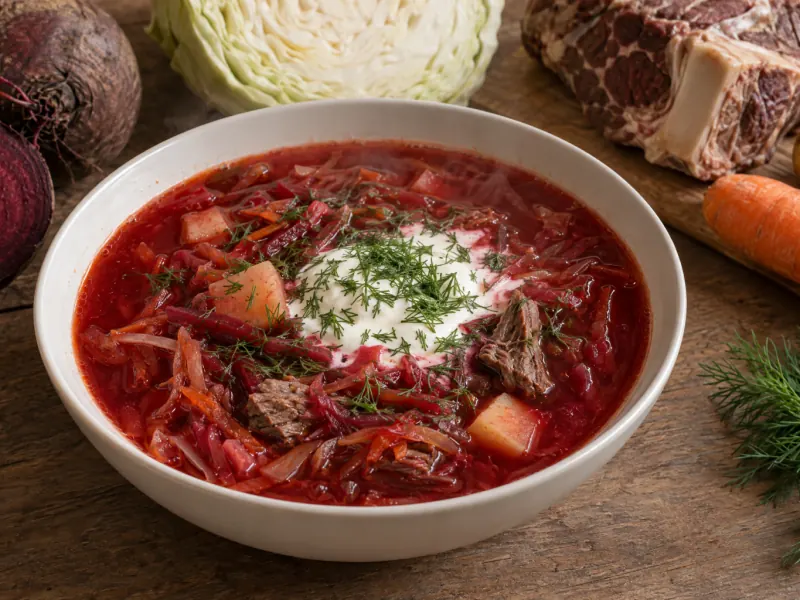
Ukrainian borscht (borshch, pronounced BORSHCH; often BORSHT in English) is a beef and beetroot soup with cabbage and potatoes, served hot with sour cream. Bone-in beef shank gives this version a full-bodied broth. The beetroot cooks separately with tomato paste and vinegar, so the soup stays deep red instead of turning brown.
- Total3 h 15 min
- Servings10
- DifficultyMedium
Ingredients
broth
soup
to serve
Method
Start the broth
Put the beef in a large stockpot, cover with the cold water and bring to the boil over medium-high heat. Skim off the grey foam as it rises until the surface is mostly clear.
Look for: The foam stops rising and the liquid looks clear rather than cloudy grey.
Simmer the beef
Add the bay leaves, peppercorns and 1¼ tsp salt, lower the heat and simmer, partly covered, for 1½–2 hours. The beef is ready when it pulls easily from the bone; at this point it is well past 145 °F (63 °C). During the last 30 minutes of simmering, start the onion, carrot and beetroot in the next two steps.
Look for: A fork slides into the meat with no resistance and the meat comes away from the bone.
Soften the onion and carrot
While the beef simmers, heat the oil in a large frying pan over medium heat. Cook the onion and carrot, stirring often, for 6–8 minutes.
Look for: The onion is soft and translucent with lightly golden edges.
Cook the beetroot
Add the beetroot, tomato paste, vinegar and sugar to the pan and cook, stirring, for 12–15 minutes, covering the pan for the last 5 minutes if the beetroot is still firm. Add a ladle of broth from the stockpot (½ cup (120 ml)) if the mixture starts to catch.
Look for: The beetroot is tender with no crunch and the mixture is a glossy, deep ruby red.
Strain and shred
Lift out the beef and strain the broth through a sieve back into the cleaned pot, discarding the bay leaves and peppercorns. When the beef is cool enough to handle, shred it into bite-sized pieces, discarding bone, fat and gristle.
Look for: The broth is clear and free of bits; the beef is in bite-sized shreds with no gristle.
Add the potatoes
Bring the strained broth back to the boil, add the potatoes and the remaining 1¼ tsp salt, and simmer for 10 minutes.
Look for: A knife meets slight resistance in the centre of a potato cube.
Add the cabbage
Stir in the cabbage and simmer for 8–10 minutes.
Look for: The cabbage is tender but still has a little bite, and the potatoes are soft.
Combine and finish
Stir the beetroot mixture and shredded beef into the pot and heat at a gentle simmer for 5 minutes without letting it boil hard. Turn off the heat, stir in the garlic, ¾ cup (7.5 g) dill and some pepper, then taste and adjust the salt.
Look for: The whole pot is an even deep red and the beef is heated through.
Rest and serve
Cover and leave the borscht to stand for 15–20 minutes. Ladle into bowls and top each with a spoonful of sour cream and the remaining dill.
Look for: The soup is still steaming hot and the sour cream swirls pink at the edges.
Why this works
- Cooking the beetroot separately with tomato paste and 1 tbsp vinegar keeps its red pigment stable; beetroot simmered for a long time in plain broth fades to orange-brown.
- Bone-in shank gives the broth body from the bone and connective tissue, so 3 litres of water turns into a full-flavoured stock without any stock cubes.
- The potatoes go in 10 minutes before the cabbage because they need longer; adding both together leaves the cabbage limp by the time the potatoes are cooked.
- The 15–20 minute rest lets the garlic and dill settle into the soup and softens the sharp edge of the vinegar.
Common mistakes
- Boiling the soup hard after the beetroot goes in dulls the colour; keep it at a gentle simmer from that point and reheat leftovers gently.
- Under-seasoning: the potatoes and cabbage absorb a lot of salt, so taste again at the end and add more if the broth tastes flat.
- Grating the beetroot too finely makes it turn to mush; use the coarse side of the grater or cut it into thin matchsticks.
Swaps
- bone-in beef shank (cross-cut) → bone-in beef short ribs or pork ribs. Beef short ribs take the same time as shank; pork ribs are a common choice in Ukraine and need about 1¼ hours.
- white vinegar → 1 tbsp lemon juice. Works the same way for keeping the colour; add a little more at the end if the soup tastes sweet.
- full-fat sour cream → smetana or crème fraîche. Smetana is sold in Eastern European shops; crème fraîche is closest in the UK and Australia.
- sunflower oil → rapeseed (canola) oil or lard. Any neutral oil works; lard adds a richer flavour.
Storage
Cool quickly (divide into shallow containers) and refrigerate within 2 hours, covered, for up to 4 days; the flavour deepens after a day. Freeze for up to 3 months, though the potatoes turn slightly grainy. Reheat gently over medium-low heat until steaming throughout, without boiling hard, and add sour cream only when serving.
Scaling
To double, use a 10–12 litre pot; the broth needs the same simmering time, but allow a few extra minutes for the soup to return to a simmer after adding the vegetables, and cook the beetroot in two pans or a wide pot so it softens rather than steams. To halve, use a 4 litre pot and keep the same simmering times.
Make ahead
Make the broth and shred the beef up to 2 days ahead and refrigerate separately; lift off the solidified fat before reheating. The whole soup can be made a day ahead and reheated gently.
Nutrition per serving
Nutrition is not shown because it could not be calculated reliably from the ingredients.
Contains
- Milk
Derived from the ingredient list. Always check the labels of the products you buy. Allergens and health
Questions
Why did my borscht turn brown or orange?
The beetroot was most likely boiled for too long or cooked without enough acid. Cook it separately with the vinegar and tomato paste, add it near the end, and keep the soup below a hard boil.
Can it be made without meat?
Yes, meatless borscht is a recognised variant. Use a vegetable broth and add a handful of cooked white beans for body, keeping the same method for the beetroot.
What is it served with?
In Ukraine borscht is commonly eaten with rye bread or pampushky, soft buns brushed with garlic oil.
Cook next

Published November 20, 2026 · Updated · Published by Recipe Worldwide · How we make recipes