Barszcz (Polish Clear Red Beet Soup)
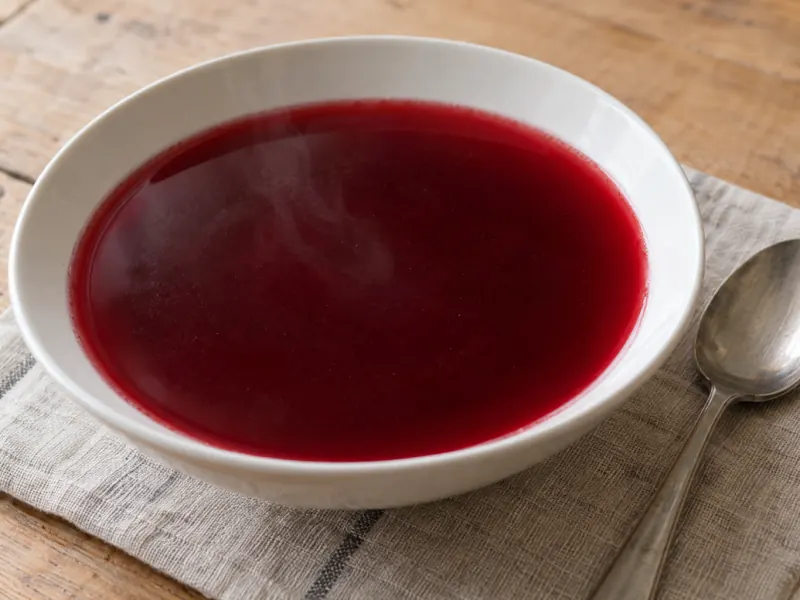
Barszcz czerwony (barshch tsher-VOH-nee) is the clear ruby beet broth served at the Polish Christmas Eve supper. This version builds a meatless stock from root vegetables and dried wild mushrooms, strains it clear, then sours it with zakwas and warms it gently so the colour stays bright.
- Total1 h 55 min
- Servings6
- DifficultyEasy
Ingredients
Method
Start the vegetable stock
Put the beets, carrots, parsley root, celery root, leek and onion in a large pot about 9½ in (24 cm) across with the bay leaves, allspice and 6½ cups (1.5 l) of the water. Bring to a boil.
Look for: Bubbles break across the whole surface.
Soak the mushrooms
While the vegetable stock heats, put the mushrooms in a small saucepan, pour over 2 cups (500 ml) of the water just off the boil and leave them to soak for 20 minutes.
Look for: The mushrooms are soft and pliable and the water has turned light brown.
Simmer gently
Lower the heat so the stock barely simmers, set the lid slightly ajar and cook for 45–50 minutes. Skim off any foam that collects at the edges.
Look for: The beets are soft and the liquid is deep red.
Simmer the mushroom stock
Cover the mushroom pan and cook the mushrooms in their soaking water over low heat for 30 minutes, alongside the vegetable stock.
Look for: The mushrooms are tender all the way through when pierced with a knife.
Strain both stocks
Line a fine sieve with damp kitchen paper (paper towel) or a clean cloth and strain the mushroom liquid into a clean pot, leaving any grit behind; keep the mushrooms for uszka filling or another dish. Remove the lining, lift the vegetables out of the stock with a slotted spoon and discard them, then pour the vegetable stock through the plain sieve into the same pot.
Look for: The combined stock is clear, with no bits of vegetable floating in it.
Infuse the garlic
Drop the crushed garlic into the hot stock and leave it off the heat for 10 minutes, then lift it out with a slotted spoon.
Look for: The stock smells clearly of garlic.
Add the zakwas
Pour in the zakwas and set the pot over low heat. Warm it only until it steams, without letting it boil.
Look for: Steam rises from the surface but no bubbles break it; the colour turns bright ruby.
Season
Add two-thirds of the salt and a little pepper, taste, then add the rest of the salt only if needed, as zakwas is often salted already. Stir in the sugar only if the soup tastes too sharp.
Look for: The soup tastes clearly sour and earthy, rounded rather than harsh.
Serve
Ladle the hot barszcz into warmed bowls or mugs and serve straight away.
Why this works
- Straining the mushroom liquid through kitchen paper or a cloth matters because dried mushrooms often carry sand that settles in the soaking water and would cloud the soup.
- The zakwas goes in at the end and is never boiled: heat dulls the ruby colour towards brown and long boiling can make barszcz bitter.
- Keeping the vegetable stock at a bare simmer for 45–50 minutes draws flavour from the beets and roots while keeping the liquid clear.
- About 500 ml of zakwas to the strained stock gives a clearly tart soup; the optional teaspoon of sugar only rounds off the edge.
Common mistakes
- Boiling the soup after the zakwas goes in turns it from ruby to brownish. Warm it only until it steams.
- Using vinegar instead of zakwas gives a sharp, flat acidity instead of an earthy sourness. Look for bottled beet kvass in Polish or Eastern European shops.
- Pouring the mushroom soaking water straight into the pot carries grit into the bowls. Always strain it through a lined sieve.
Swaps
- fermented beet juice (zakwas buraczany or beet kvass) → lemon juice, added a spoonful at a time to taste. A last resort when no zakwas or beet kvass is available: it gives sourness but none of the earthy fermented depth, and the colour will be less vivid. Avoid vinegar, which tastes harsher.
- parsley root (Hamburg parsley) → parsnip. If you cannot find parsley root (sold as Hamburg parsley in some shops), parsnip works in the stock but is a little sweeter.
- celery root (celeriac) → celery stalks. Two stalks give a similar savoury note if celeriac is out of season.
Storage
Cool, cover and refrigerate for up to 4 days, or freeze for up to 3 months. Reheat gently over low heat until steaming and do not let it boil, or the colour will fade.
Scaling
To double, use a pot of at least 8 litres for the vegetable stock and strain it in batches; simmering times stay the same. To halve, a 3-litre pot is enough and the mushroom stock can simmer in a very small pan.
Make ahead
Homemade zakwas takes 4–5 days and makes about 2 litres, more than this recipe needs. Dissolve 1 tablespoon (about 18 g) of fine salt in 2 litres of lukewarm boiled water. Pack 1 kg peeled, thinly sliced raw beetroot into a 3-litre jar with 4 smashed garlic cloves, 2 bay leaves and a crust of rye bread, pour over the brine and weigh the beets down so they stay submerged. Cover with a cloth and leave somewhere warm. Skim off any foam or thin white film; if fuzzy or coloured mould appears, throw the batch away. When it is clear, ruby and pleasantly sour, strain it into clean bottles and refrigerate; it keeps for at least 2 weeks. The strained soup stock keeps 2 days in the fridge; add the zakwas and garlic when you warm it to serve.
Nutrition per serving
Nutrition is not shown because it could not be calculated reliably from the ingredients.
Contains
- Celery
Derived from the ingredient list. Always check the labels of the products you buy. Allergens and health
Questions
Is there a substitute for zakwas in barszcz?
Zakwas gives barszcz both its sourness and its deep colour, so it is worth making or buying: Polish shops sell it in jars as zakwas buraczany, and some health-food shops sell beet kvass. Homemade zakwas takes 4–5 days (see Make ahead); lemon juice is only an emergency stand-in.
What do you serve with barszcz?
On Christmas Eve it is served with uszka, small dumplings filled with wild mushrooms and onion or with sauerkraut and mushrooms. Croquettes (krokiety) or small filled pastries are other common sides.
Why did my barszcz turn brown?
It was most likely boiled after the zakwas went in. Keep it just below a simmer when reheating.
Cook next

Published November 23, 2026 · Updated · Published by Recipe Worldwide · How we make recipes